B2B Lead Generation: How One Live Workshop Made $83K
You know you need more leads. You also know where the time for marketing would come from: your evenings.
Cold emails to strangers feel wrong. Cold calls feel worse. New sales hires sit there with nobody to call. And the moment you get busy closing, the pipeline goes quiet and stale again.
There's a quieter way. One live hour a month, where the right people come to you, taste how you work, and raise their hand. You don't chase them. You lead. My last one made $83,000.
The recipe is short. One small problem. Three partners, six emails. One real person's problem, solved live.
I talked this through with Dave Wakeman on The Business of Fun Podcast (April 2025). Listen to the full conversation: Simon Severino on The Business of Fun
Why a live hour beats another campaign
When a new cheese shows up in the supermarket, somebody hands you a piece. You taste it before you buy it.
Your buyer wants the same thing. They have a big problem and several options. Before they send you $25,000, they want to know one thing: can I trust this person?
An hour live with you answers that. They see how you think. They feel what working with you is like. That's the taster.
Step 1: Pick one small problem they already ask you about
Start with what people already ask you. The comments under your posts. The emails. The questions on Zoom calls.
For months, everybody asked us about lead gen. Lead gen, lead gen, lead gen. So lead gen became the workshop. They told us the topic.
New market, no questions yet? Two moves:
- Ask Claude to read the Amazon reviews of a product your buyer uses. What are they looking for, and what frustrates them because they're not getting it?
- Open YouTube in an incognito window, type the first words of your topic, and watch how it completes the sentence. That's how your buyer types it.
Then shrink it. "Sales" is too big. "How to close in two calls" fits in 60 minutes. The test: big enough that they want to come, small enough that you solve it inside the hour.
🐬 That shrinking is the real work. Everything else is execution.
Step 2: Write a movie poster, not an invitation
A workshop gets filled by its poster. Three parts: a headline, three fascinations, an image.
The headline: two or three words. Big enough to read on a thumbnail. Eight words on a LinkedIn image hit different than three.
I sharpen it with Claude. I tell it: you are David Ogilvy and Rick Rubin, discuss the best headline for this topic with me. Rubin says it's not groovy enough. We go back and forth until something excites all three of us. Rory Sutherland joins sometimes too.
The three fascinations: know, have, feel. One delegation master class went like this:
- You will know exactly which two tasks to delegate.
- You will have a clear plan for handing them over.
- You will feel relieved, because a few hours just came off your week.
Then I ask Claude to criticize it the way Ogilvy would. A few rounds until it clicks.
The image: would you go to the movies for this poster? Emotional, human, interesting.
And call it a workshop. Never a webinar. "Nobody needs a presentation." People show up for something live, where somebody actually helps them.
Step 3: Fill it with three partners, two emails each
We pick a date three weeks out. That's why it's monthly: three weeks to fill, plus a buffer. Same rhythm every month, and every round gets easier.
First we post it inside our own community. Then three strategic partners each send two emails to their people. Partners we've worked with for a long time, who we trust with our reputation. Six emails. That fills the room.
No three partners yet? Look at who already serves your buyer with something different. Their bookkeeper. Their agency. Their software. Same buyer, no competition, every reason to help each other.
🐯 Notice what's missing. No ad budget. No cold list. No evenings spent writing posts. Three relationships do the work your calendar can't.
Step 4: Solve one real person's problem, live
The first minutes are warm-up and questions. I watch the chat. Four or five people have the energy and the courage to open up in front of a group. I pick one.
Then we spend 10 to 20 minutes actually solving their problem. Their website doesn't convert? We rewrite the copy, the flow, the button contrast. Live.
We call it a prototype. The opposite is explaining a framework, and nothing is more boring. "I can Google a framework." Everyone else is in the room for the same reason: to taste the magic on a real case. So everybody gets to speak, breakout groups of three take one angle each, and the chat keeps pinging the whole time.
Here's the part the old webinar playbook gets backwards. I don't open with who I am. Problem first. Solution second. Only at the end: this is what we do, this is where you find us, this is the next step.
Step 5: Sell softly, and let them come to you
At the end, I ask who wants to explore working together. Type an M in the chat if you want to talk by email. A B if you want to book a time. Drop the calendar link in the chat, and people book on the spot.
That last workshop: 10 people raised a hand. Three of them booked a Sprint (our 90-day sales acceleration) in the same week, at around 9,000 a month. That's the $83,000.
🌴 Look at who holds control in that moment. You didn't chase anyone. You didn't beg for a meeting. They watched you solve a real problem, and they asked for the next step. You walk into the sales call as the expert they just watched at work, already leading it.
Never cancel for low turnout
My early workshops had three people. Five. Ten. "I never cancelled one because it wasn't enough people."
One day only five signed up. Rain outside, nothing better to do. I almost cancelled. "It's more fun to do it with five people than to go do something else when it's raining."
The number one name on my Dream 100 list (the dream clients you commit to reaching) was Google. I'd never gotten a meeting.
Somebody from Google was one of those five. Five minutes after the workshop, they asked if they could propose to their boss that they switch consultancies. That became a gig.
🐬 The room size doesn't decide the outcome. The one right person in it does.
Your first workshop, in order
- Pick one problem from what people already ask you. Shrink it to 60 minutes.
- Write the poster: a 2-3 word headline, three fascinations (know, have, feel), one image.
- Call it a workshop. Never a webinar.
- Ask three trusted partners for two emails each, three weeks out.
- Solve one real person's problem live, 10 to 20 minutes.
- Say who you are at the end. M for email, B to book, calendar link in the chat.
- Never cancel. Five people is enough.
Skip it, and next month's pipeline still runs on your evenings.
🐯 Pick the problem this week. Look at the last ten questions in your inbox. One of them is your first workshop.
Picture the month after: conversations you didn't chase, calls where you lead from the first minute, and evenings that stay yours. That's Sprintlife: control in sales, and the time to live the life you built the company for.
Listen to the full conversation with Dave Wakeman: The Business of Fun with Simon Severino
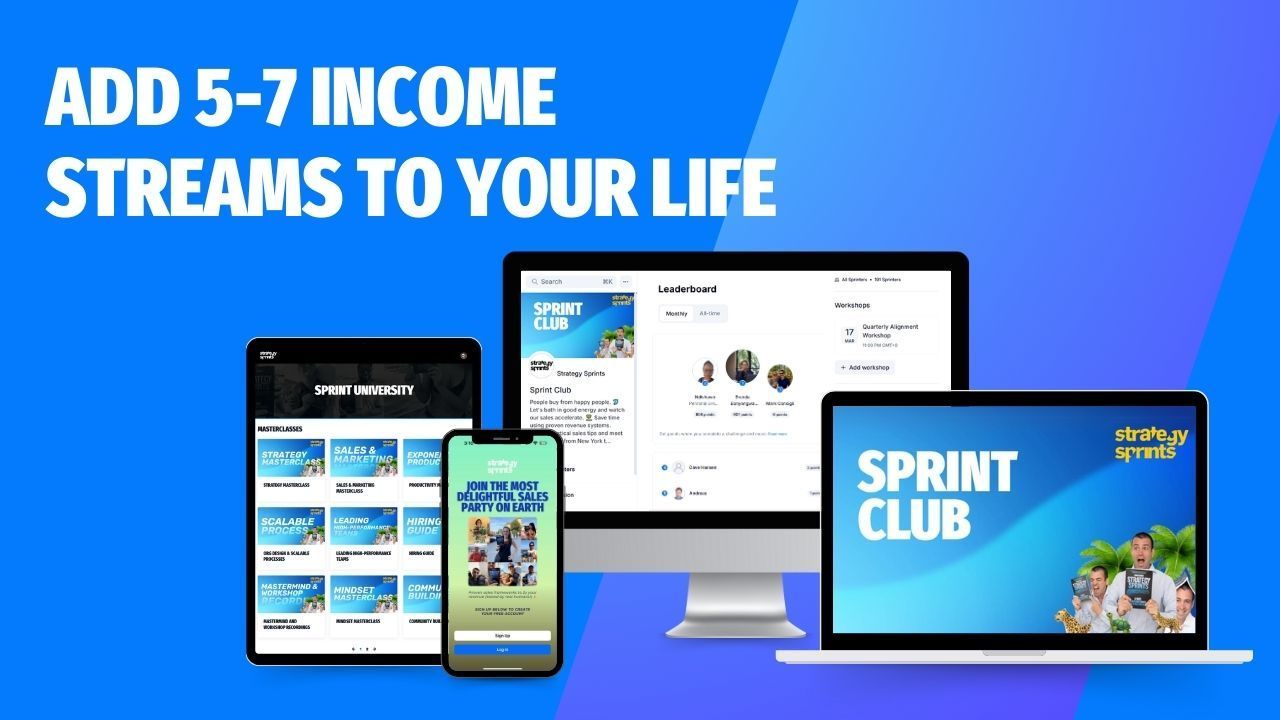
Grab the free tools and join the Sprint Club: https://www.strategysprints.com
Ready to accelerate now? Book a Discovery Call: https://calendly.com/strategysprint/discovery-call
Happy hunting.
Simon & The Sprinters 🐬⚡️🐆
Lead your next deal, first call to signature. 🌴
The 36 Sales Gaps Checklist: 36 places a deal dies, and the fix for each. Free, one page.
Free. You get the checklist, then more sales tools like it by email from Strategy Sprints. Leave in one click, any time.