Forty Seconds — John Boyd and the Art of Speed
A fighter pilot at Nellis Air Force Base had a standing bet.
Start with the opponent on his tail... the worst possible position in air combat. Within forty seconds, he would reverse the situation and have his guns locked on.
Forty dollars per bout. He never lost.
Not once. For six years. Against every combat pilot in the country.
They called him "Forty Second Boyd." And the principle that made him unbeatable in the sky would later reshape how wars are fought, how the best fighter jets in history were designed, and (if you let it) how you run your business.
The principle is simple: the one who cycles through decisions fastest wins.. even against a superior opponent.
The MiG Problem
Korea, 1953. The American F-86 Sabre versus the Soviet MiG-15.
On paper, the MiG was better. It climbed faster. Turned tighter at altitude. Heavier cannon armament. Higher combat ceiling. In every measurable way, the MiG should have dominated.
The F-86 had a 10-to-1 kill ratio.
The US Air Force couldn't explain it. Boyd figured it out.
The F-86 had two advantages that didn't show up in the spec sheets:
A bubble canopy. The pilot could see in every direction. The MiG had a framed canopy that blocked rear visibility. The F-86 pilot could observe the battlespace faster.
Hydraulic flight controls. The F-86 could transition from one maneuver to another almost instantly. The MiG used mechanical cables. A fraction of a second slower on every move.
Neither advantage was about raw performance. Both were about speed of transition. See faster... change faster.
That gap (a fraction of a second per cycle) compounded across dozens of maneuvers in a dogfight. The MiG pilot was always reacting to the F-86's last move. Always a beat behind.. always disoriented.
Boyd turned this observation into a theory. Then the theory into a framework. Then the framework into the most influential military strategy of the twentieth century.
He called it the OODA Loop.
Observe, Orient, Decide, Act
Four steps. Continuous loop. The foundation of competitive advantage in any domain where speed matters.
Observe. What is happening? For a pilot: scan the horizon, read the instruments, check your six. For a founder: read the market signals, listen to customer conversations, watch competitor moves... look at the numbers.
Orient. What does it mean? This is the step everyone skips. Boyd said it was the most important one. Orientation is where your mental models, your experience, your industry knowledge all converge to interpret what you've observed.
Decide. Not a final answer. A hypothesis. An experiment. A bet you'll test and learn from.
Act. Ship. Send. Call. Launch. And the moment you act, the results feed back as new observations. The loop starts again.
Here's the insight that made Boyd famous: it's not about making the best decision. It's about cycling through the loop faster than your opponent.
What This Means for You
You're running a company at $1M to $7M. You have competitors. Some bigger.. better funded.. bigger teams.
You can still beat them. Not by being better. By being faster.
The Weekly OODA
Most founders run on annual plans. Quarterly goals. Monthly reviews. That's a cycle time of 30 to 90 days.
What if your cycle time was 7 days?
Monday... Observe. What happened last week? What did customers say? What moved?
Tuesday... Orient. What does it mean? What patterns? What assumptions were wrong?
Wednesday... Decide. One experiment. One hypothesis.
Thursday and Friday... Act. Ship it. Send it. Launch it.
A founder running this 50 times per year will destroy a competitor running it 4 times. Because the learning compounds.
Don't optimize for maximum size. Optimize for maximum agility. The F-16 wasn't designed to be the biggest or fastest. It was designed to change direction faster than anything in the sky.
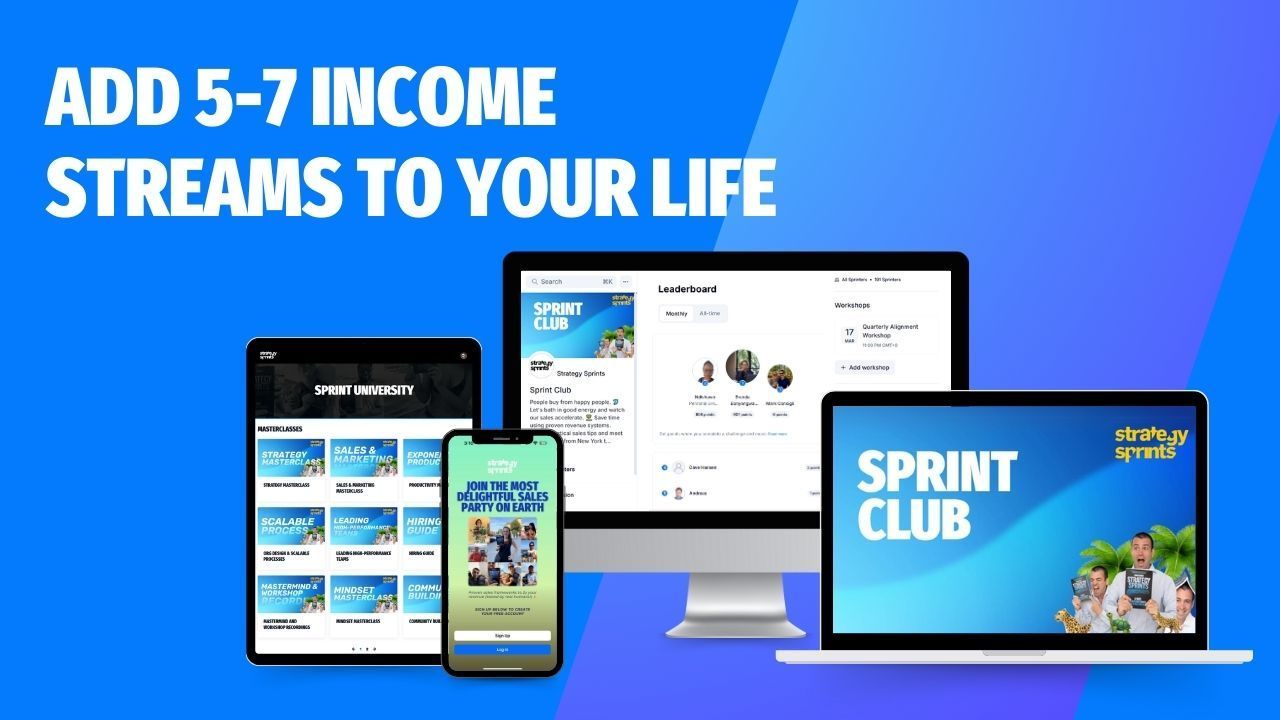
If you want a structure for running rapid OODA cycles on your pipeline, pricing, and positioning.. that's what we do inside Sprint Club. 251 founders cycling faster than their competition. Seven-day free trial at strategysprints.com.
Keep rolling,
Simon & The Sprinters
Get our expert sales tips delivered
By submitting you agree to receive our weekly Strategy Sprints Newsletter as well as other promotional emails from Strategy Sprints. You may withdraw your consent at any time via the “Unsubscribe” link in any email or view our privacy policy at ant time.