Your CRM Calls Them a Lead. Sales Calls Them a Contact. That's Why Your AI Is Guessing.
Right now, somewhere in your business, a decision is sitting on your desk.. You don't have every fact. There's no time to pull five people into a room just to agree on what's actually going on. So you guess. Or you wait while the deal sits there. Neither is good. Your competition isn't waiting.
Here's the part nobody says out loud: whatever AI tool you just bought cannot fix that. A smarter model won't. A better prompt won't either. The problem was never the model. The map was missing the whole time.
Why $30K deals and $300 million deals hit the same wall
I sit in rooms every week where deals get made.. $30K, $70K, $300K, once a $300 million deal. Founders bring me in for one reason. They show me the actual pipeline. The actual deal contracts. The litigation, if there is any. What they plan to do next. They want my alpha, a small refinement that elevates the deal. A few million dollars of difference, for them. That's why they invite me into the room.
And almost every time, the fix isn't a new tactic. It's this: your CRM calls that person a contact. Sales calls them a lead. Delivery calls them an account. It's the same human being. Three private definitions, on three separate spreadsheets.
That mismatch is exactly how deals get lost in the middle of your own pipeline. It's confusing to you. It's confusing to your team. And it's completely confusing to any AI agent you try to plug in, because it's reading three different spreadsheets that disagree with each other about who this person even is.
An AI can't fix a map problem
Think about onboarding a new hire. Their whole first month is spent asking "what does this mean around here?" Every new AI agent does the exact same thing, except it doesn't ask. It guesses.
So you did the workshop. You watched the demo. You plugged the AI in. It doesn't work. It can't work. Things get worse, not better, and you're putting in more effort for less. Here's the actual blind spot: you don't have too little AI, and you don't have too little intelligence in the room. You have no shared map. If your full business isn't available as one real-time source of truth, the AI can't really help you, and honestly, neither can your people.
Feed the same person into three tools running three definitions and you get three confident, wrong answers that don't agree with each other. You get pulled back into the business again and again to untangle it, and you feel like an idiot for building a company that still needs you to solve small stuff. Call it what it actually is: expensive noise, dressed up as intelligence.
Isolate before you integrate
Most mornings this month I've been rowing on the Danube. Eight rowers, one boat. In training, we almost never row a full stroke. We isolate the pieces.. catch only, legs only, until it's boring. Only on race day do we put it all together into one motion.
For your business, that's naming what a "deal" actually is before you let an agent touch your pipeline. What's a prospect. What's a contact. What's a lead. What's a statement of work versus a signed statement of work. Nobody skips the boring step in rowing. Everybody skips it in AI.
Most businesses bolt AI onto a company that was never mapped, and then wonder why it creates more chaos instead of less. That's racing before you've trained the stroke.
Build the map: nouns, verbs, rules
Palantir calls this an ontology. I've worked with the Palantir version of it long enough to know the shape: you need the nouns, the verbs, and the rules.
Nouns.. what your business is actually made of: prospect, deal, member, partner, recording, social post, offer. And for each one, where the single source of truth lives, especially when there's more than one place claiming to be the truth.
Verbs.. who does what.
Rules.. who's allowed to make which decision, at which level. Can anyone change the price? Who actually can?
Picture it as one whiteboard in your office. One column of nouns: Prospect, Deal, Member. One column of verbs: who closes it, who delivers it. One column of rules: who's allowed to change the price. That's the whole map.
It used to take weeks to build this with a client using the Palantir approach. Now we build it in a few days.
Once that map exists, an AI agent has something real to read before it touches your business. Before that, it's guessing in a nicer font. And you're guessing right alongside it.
One client, Larissa Kravitz, runs Investorella, teaching women how to reach financial freedom faster. A week after building her map, she told me: "I felt in control of my business, and my trajectory was much clearer." One week. Not a quarter. Not a year.
The only real job left for a CEO
Inside our own company, this isn't theory. We run about 43 agents right now, and they all read one shared map, the ontology. Above that ontology sits the whole compounding firm: how we attract people, how we close deals, how we deliver and hopefully over-deliver on what we promised, and how each week compounds on the last.
Every morning, the agents read that shared map and brief me. Every evening, they sweep the day's meetings.. someone decided to change a price, go update it. A new testimonial came in, post it. The website runs on Kajabi, go update the website. By the time I've had coffee, the administration is already done.
That frees up the one thing that actually compounds: thinking about the trajectory of the business. Should we license the methodology. Should we follow up on a deal. Should the new book go to a different country in a different language. Higher-leverage questions, not admin.
That's how a solo founder ends up collaborating with someone like Jay Abraham, a legend in deal-making. Not because I chased the relationship, but because I had the hours in the week to think at that level, and you attract the frequency you bring to the table. A year ago I would have said the CEO's job also includes hiring and firing. It doesn't, not really. Agents should be doing agent recruitment for you.
And it keeps compounding. Every week the map gets sharper, because every week's chaos turns into next week's rule. You're not solving the same problem twice, and you're not rolling the same stone up the same hill like Sisyphus. You're building something that holds what you learned.
The test that tells you if AI is actually helping
Here's the real test. Share your ontology with your AI and ask it one big question. Every second day I do exactly this: "You're the new CEO. This is everything available to you. What would you do to increase profits 15% by December? What would you do to make this company more self-learning, self-adapting, self-correcting? What would you stop doing because it isn't a high-leverage outcome?"
If that gets you a useful answer, your map is working. That's a board member, on demand, for the cost of a monthly AI subscription. If you don't have the map yet, you're flying blind no matter which model you're running, no matter how good the prompt is.
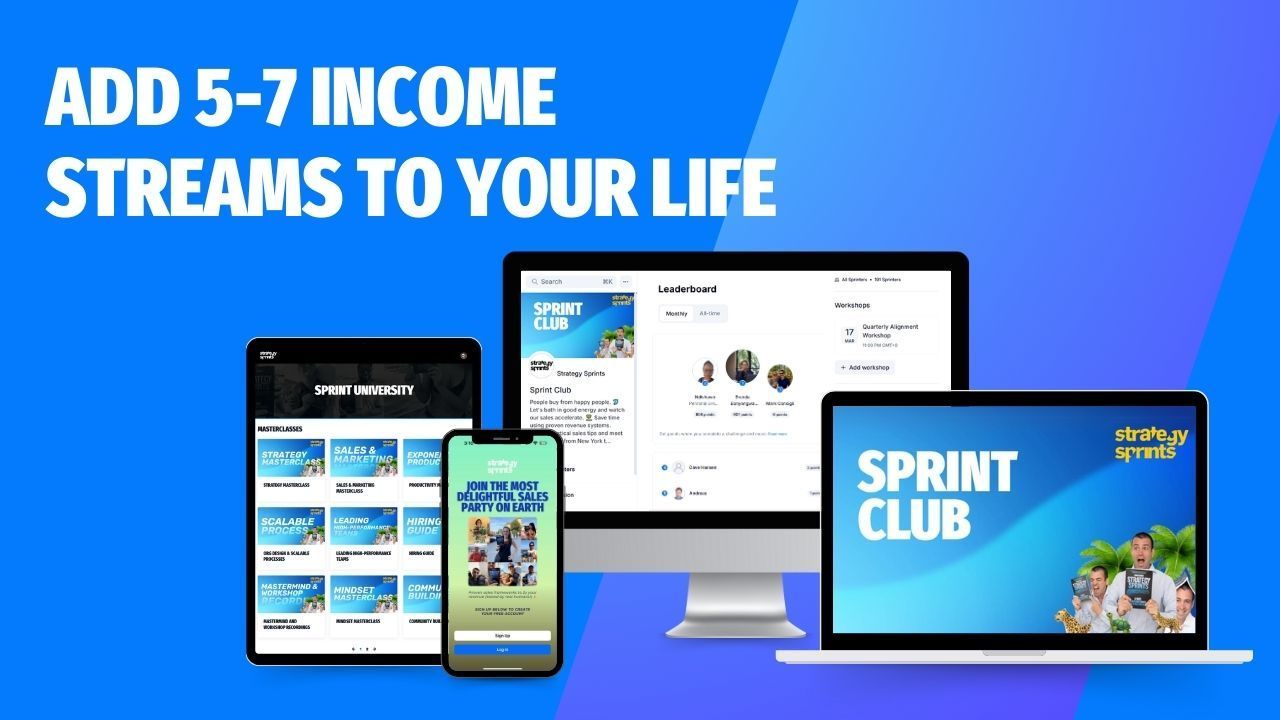
Build the map. Or use ours. Sprint Club gives you the ontology tools and templates free for 7 days, so you're not starting from a blank page: https://www.strategysprints.com
📞 Ready to accelerate now? Book a Discovery Call: https://calendly.com/strategysprint/discovery-call
Happy hunting. Simon & The Sprinters 🐬⚡️🐆
Lead your next deal, first call to signature. 🌴
The 36 Sales Gaps Checklist: 36 places a deal dies, and the fix for each. Free, one page.
Free. You get the checklist, then more sales tools like it by email from Strategy Sprints. Leave in one click, any time.