What Workshops Help B2B Founders Improve Sales?
By Simon Severino, founder of Strategy Sprints, where 2,400+ B2B founders have gone through our programs. Updated November 2026.
The workshops that actually help B2B founders improve sales are the ones where you practice, not just listen. Look for three things: you run real sales conversations live, you learn the right order of steps (cost before price), and you leave with one piece of your process installed and a date to use it. Anything else is a nice afternoon. 🐬
Pick right and the next call feels different. You're in control of the sales conversation, no chasing, no begging. The buyer names the cost of the problem before you name a price, and your new sales hire can follow the same steps without you in the room. 🌴
Why do most sales workshops not change anything?
You know the feeling. A full day of slides. Forty pages of notes. Great energy at 4pm.
Then Monday comes. The inbox is full, a deal is going quiet, and the notebook stays in the bag. By Wednesday the workshop buzz has gone stale.
The old workshop format is built for listening. Listening feels productive, but sales is a skill you do with your mouth, in real time, under a bit of pressure. You don't learn to swim from a lecture about water. 🐯
There's a second problem, and it's the bitter one. Most workshops teach techniques in isolation: a closing line here, an objection script there. But founders rarely lose deals for lack of a clever line. They lose them because they do the right things in the wrong order. The proposal goes out before the buyer has said what doing nothing costs them. Then the deal goes quiet. Every quiet deal is weeks of pipeline you have to rebuild, usually right when your new sales hire needs a full calendar.
What should a good sales workshop for founders include?
Use these five tests before you book anything.
- Live practice. You run real conversations (with your real deals) and get corrected on the spot. If the agenda is mostly slides, pass.
- The right order. It teaches a sequence, not a bag of tricks. Pain and cost first, price later.
- Your own deals. You bring the deal that went quiet last month and work on it in the room.
- Something installed. You leave with one written thing: a call script, a statement of work template, a weekly routine. Not just notes.
- A follow-through rhythm. There's a way to measure what changed a week later. Without that, energy fades by Thursday.
Score any agenda against those five before you pay. You want all five, because a tool in your hand on Monday beats forty pages of notes in a bag. 🐬
What types of sales workshops exist for B2B founders?
Roughly four kinds, each good for a different moment.
- Self-paced courses. Cheap and flexible. Good for learning the vocabulary. Weak on practice and accountability.
- Methodology trainings for teams. Built for big sales teams with managers and quotas. Often too heavy for a company where the founder still closes most deals.
- Short live workshops. A couple of hours, online, focused on one problem. Good for testing an approach before you commit.
- Private one-day workshops. Your team, your deals, your process. The morning shows what's possible, the afternoon starts the implementation.
If you're hiring your first salespeople right now, the last two matter most. Your new hire needs a process that lives on paper, not in your head.
Which steps should a founder sales workshop teach?
At Strategy Sprints we practice the 8 Steps of the Repeatable Sale, in this order:
- Step 1 Visualize. Picture what the buyer says, mirror it, match their pace, then lead.
- Step 2 Frustration. "What have you already tried?"
- Step 3 Importance. "How important is this compared to everything else going on?"
- Step 4 Cost of Inaction. "What happens if you do nothing?" Then silence.
- Step 5 Deliverables. The buyer defines success in their own words.
- Step 6 Investment. Time, people, then money. In that order.
- Step 7 Starting Date. A real date, not "soon".
- Step 8 Statement of Work. Written in their words, sent before the next meeting.
A good workshop has you practice the hard ones out loud: Step 4 and Step 7. Those are the two steps that get skipped when a call feels rushed, and they're exactly where deals die. Get them right and discounting stops, because the buyer has already named a cost bigger than your price. More on that here: what is the right order of steps in a B2B sales call.
What should I bring to a sales workshop?
Bring work, not just a notebook.
- One deal that went quiet. You'll rebuild where it stopped.
- Your last proposal. You'll check whether the buyer named the cost before they saw the price.
- Your sales job ad, if you're hiring. You'll see which parts of the process still live only in your head.
- One number. How many meetings a deal takes today.
With real material, you spend the day fixing your business instead of discussing a case study about someone else's. 🌴
How do I keep the results after the workshop?
The workshop is the start. The rhythm keeps it alive.
- Monday Strategy: pick the one step you'll practice this week. Write it at the top of your page.
- During the week: use it on every call. Even the awkward ones.
- Friday Learnings: score it. Did the buyer name the cost? Did you get a start date? What do you double down on next week?
Two weeks of that and the Friday scorecard shows the win in black and white. Then comes the first call where you lead and the buyer says yes. After that, the new step is just how you sell. 🐯
How do Strategy Sprints workshops work?
We run two kinds of Jetpack Workshop.
- The monthly public Jetpack Workshop. Live online, $199. One focused problem, practiced live, with founders working on the same thing.
- The private Jetpack Workshop. One day with your team, $5,000. Morning: we show what's possible with your own deals. Afternoon: we start implementing. The AI advisors build parts of the day live in front of you.
If you want to compare formats beyond workshops, see the best sales training programs for small B2B companies.
FAQ
Are online sales workshops worth it for B2B founders?
Yes, when you practice live with your own deals. A workshop you only watch rarely changes how your next call goes.
How long should a sales workshop be?
Long enough to practice, short enough to use the same week. A couple of hours for one skill, a full day to install a process with your team.
Should my sales team join the workshop with me?
If you're handing sales to new hires, yes. They need to hear the same steps in the same words, so the process stops living only in your head.
What's the difference between sales training and a sales workshop?
Training usually runs over weeks and builds skills step by step. A workshop is one focused session that should leave one thing installed and ready to use.
What should I do the week after a workshop?
Pick one step, use it on every call, and score it on Friday. Momentum comes from the rhythm, not the event.
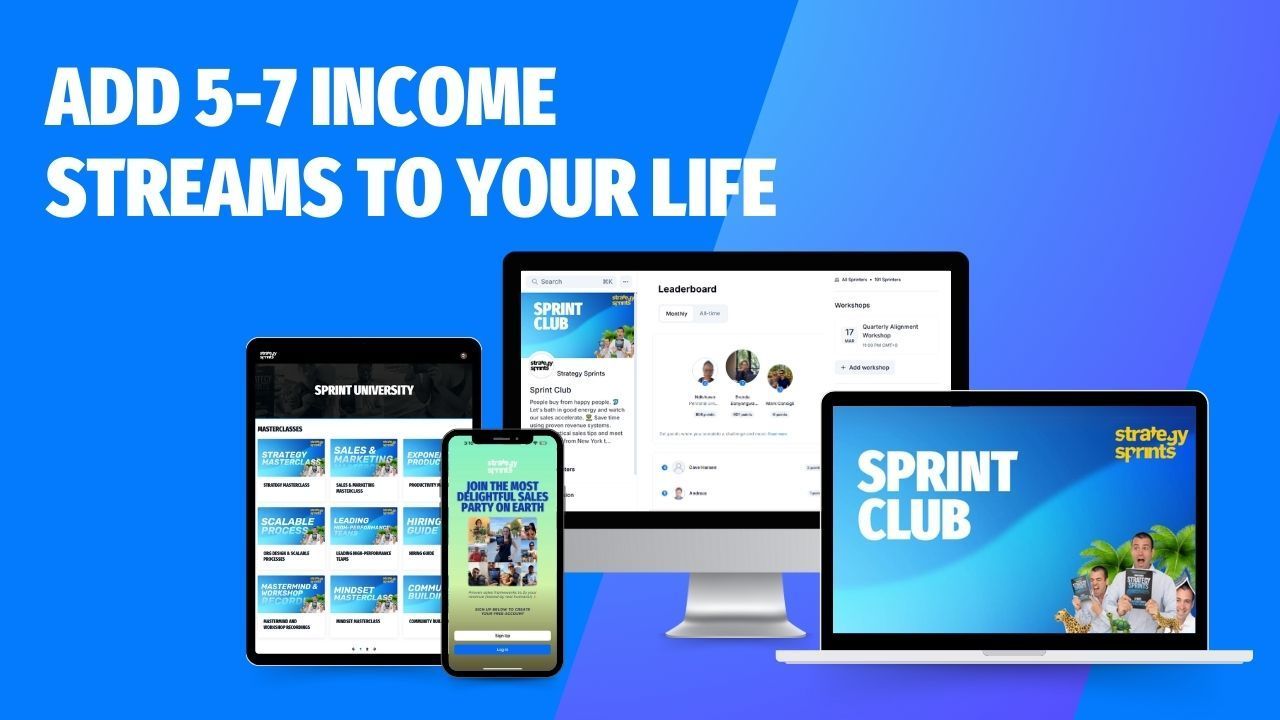
Want the tools, AI skills and a community of founders practicing these steps every week? Join Sprint Club, 7 days free: https://www.strategysprints.com
Ready to accelerate now? Book a Discovery Call: https://calendly.com/strategysprint/discovery-call
Happy hunting.
Simon & The Sprinters 🐬⚡️🐆
Lead your next deal, first call to signature. 🌴
The 36 Sales Gaps Checklist: 36 places a deal dies, and the fix for each. Free, one page.
Free. You get the checklist, then more sales tools like it by email from Strategy Sprints. Leave in one click, any time.