8 Rowing Lessons for Founders Who Want to Double Revenue (the Last One Is the Biggest)
Double revenue. Stop being the only closer. Hire salespeople who actually sell.
If those three sit at the top of your list right now, this one is for you. Some of my best lessons on all three came from a rowing boat 🌴
I had been a competitive rower for 11 months, and nobody thought I was ready for a race.
Then four people on a team believed in me, and we entered a 16 km regatta.
We turned out to be pretty fast, and we had so much fun 🐬
Then, 14 km in, we made the biggest decision of the race. I'll get to that one last.
That race taught me more about control in sales than any business book. Here are the lessons from it, plus a few more I picked up in the boat.
1. Getting great at rowing works the same way as getting great at anything
Rowing has no secret. You learn the stroke, repeat it thousands of times, measure it, fix one thing and go again.
Sales works the same way. The old story says selling is a talent you either have or you don't. There's no talent gene here. There's a sequence, and you can practise it.
We use the 8 Steps of the Repeatable Sale: Visualize, Frustration, Importance, Cost of Inaction, Deliverables, Investment, Starting Date, Statement of Work. You do them in that order and practise them until they're automatic 🐯
2. You become the average of the five people you spend the most time with
Eleven months in, the people around me didn't think I was ready. Four people on a team saw it differently, and their belief got me to the start line.
That's how it works. Train with fast rowers and you get faster over time. Spend your time with people whose standards are low and your own standards slip without you noticing.
So picture the five founders you talk to most. Are they doubling revenue? Or are they explaining why this quarter is "just a tough market"?
That's why our 200K Club is exactly 5 founders. Five people who push you through your current sales wall. In the gym we call them spotters 🌴
3. Take control of your career. Don't wait for things to fall into your lap
We didn't wait to be picked. We applied.
If we had waited for someone to tell me I was ready, I would still be waiting. Waiting has a cost: while you wait, the buyer sets the pace.
In sales, waiting looks like chasing, hoping and "just checking in." It's a needy posture, and buyers hear it straight away.. in your tone, in the pause before your next question.
Being in control means you lead the conversation. You ask the questions and set the next step. You decide the starting date together, in the room. When you lead, closing starts to feel good again 🐬
4. Confidence comes from doing what you said you'd do, especially when no one is watching
Confidence comes from the 6 a.m. session you did alone, when the alarm went off and you could have rolled over. Pep talks fade by lunch.
Business is the same. Say you promise yourself 3 new conversations with ideal clients this week. Nobody will check.. except you.
Every promise you keep to yourself adds to your confidence. On the next sales call the buyer can hear it in your voice 🐯
5. You fall to the level of your own standards, not your coach's
A coach can raise the bar. A coach can't hold it up for you.
This matters most when you're hiring salespeople. Your new hires won't rise to the standards in your job post. They'll settle at the standards you actually live by every day. If you're the only closer and your process lives in your head, their bar is whatever they guess it is.
Write the standard down where everyone can see it, and practise it together out loud. Then the new hire can run the sale without you 🌴
6. Goals won't lift you. Routines are your safety net
Every rower wants the medal, and so does every other boat on the start line. So wanting it separates nobody.
What separates you is the routine you keep on the days you don't feel like it. On a bad day you don't rise to your goals. You fall back to your habits.
Our routine is simple: Monday Strategy + Friday Learnings. On Monday you set the week's one priority. On Friday you score it: what worked, what to double down on, what to drop. Then you do it again the next week.
Boring? A little. It's also why the wins show up in black and white on the Friday scorecard 🐬
7. Always have one race in front of you, even if it's 4 months away
Once that 16 km regatta was on the calendar, every session had a reason. I knew what I was training for and how many weeks were left.
Without a race, training goes stale. You still go out on the water, but it turns into exercise instead of preparation.
This works with lesson 6, not against it. Routines keep you steady, and the race gives them a direction. If you have routines but no race, you drift. If you have a race but no routines, you panic 🐯
Your company needs the same thing. Always have one dated target in front of you: close 3 new clients by 31 December, or double revenue in the next 90 days. It needs a date, not "sometime this year." The date is what makes this Monday's priority obvious.
We work in 90-day sprints for this reason. When one sprint ends, the next race is already on the calendar 🌴
8. Baseline, baseline, baseline. Then risk it.
14 km into that regatta, we had 2 km left, and we decided to go all out.
That was the biggest decision of the race, and it's the biggest lesson rowing gave me: when do you take the risk?
Picture it from your own seat: the finish still out of sight, your forearms burning, your breathing loud in your ears. You can pick 500 m before the finish, or 750 m, or 1,500 m. It doesn't matter which one. What matters is that you pick one line in the sand and decide that from there you go all out 🐬
Most teams never pick one. They do baseline training, then more baseline training, then more, and they never risk it. Meanwhile, somebody else in your market picks their line this quarter.
Without risk, your body doesn't adapt and neither does your mind. You end up with limits that exist only in your head, and your body follows your head.
When you think you're at 100%, there's probably another 30% to go. The wall you feel is the one your mind put up to protect you. Your real limit sits further out 🐯
Sales works the same way. The baseline is your weekly rhythm: prospecting, follow-ups, Monday Strategy, Friday Learnings. It keeps you in the race.
At some point, though, you have to go all out. You name the bigger number in Step 6, Investment, without apologising. You ask for the starting date in the room instead of "let's stay in touch." You call the client you've been telling yourself is too big for you.
The price you think is your ceiling, and the pipeline you think is full, probably each have another 30% in them too 🐬
Reckless? No. You've done the baseline, so you've earned the right to risk it. Speed with control.
Don't grow slow. Pick your line in the sand 🌴
What the boat taught me about Sprintlife
Nobody remembers a training session. I still remember that regatta, and mostly I remember the fun.
Rowing is intense, and so is running a company. The question is whether that intensity grinds you down or lifts you.
When you control your sales conversations, run a weekly rhythm, surround yourself with the right five people, always have a race in front of you and pick your moment to go all out, the intensity starts working for you. That's what we call Sprintlife: you're fully present, going at full intensity. And here's the sweet part.. money, thank-yous and purpose come back to you 🐯🌴
The grind is the default path, and it leaves a bitter taste. It doesn't have to be yours.
2,400+ B2B founders have gone through our programs. The moment we build all of it around is simple: the first call where you lead, and the buyer says yes 🐬
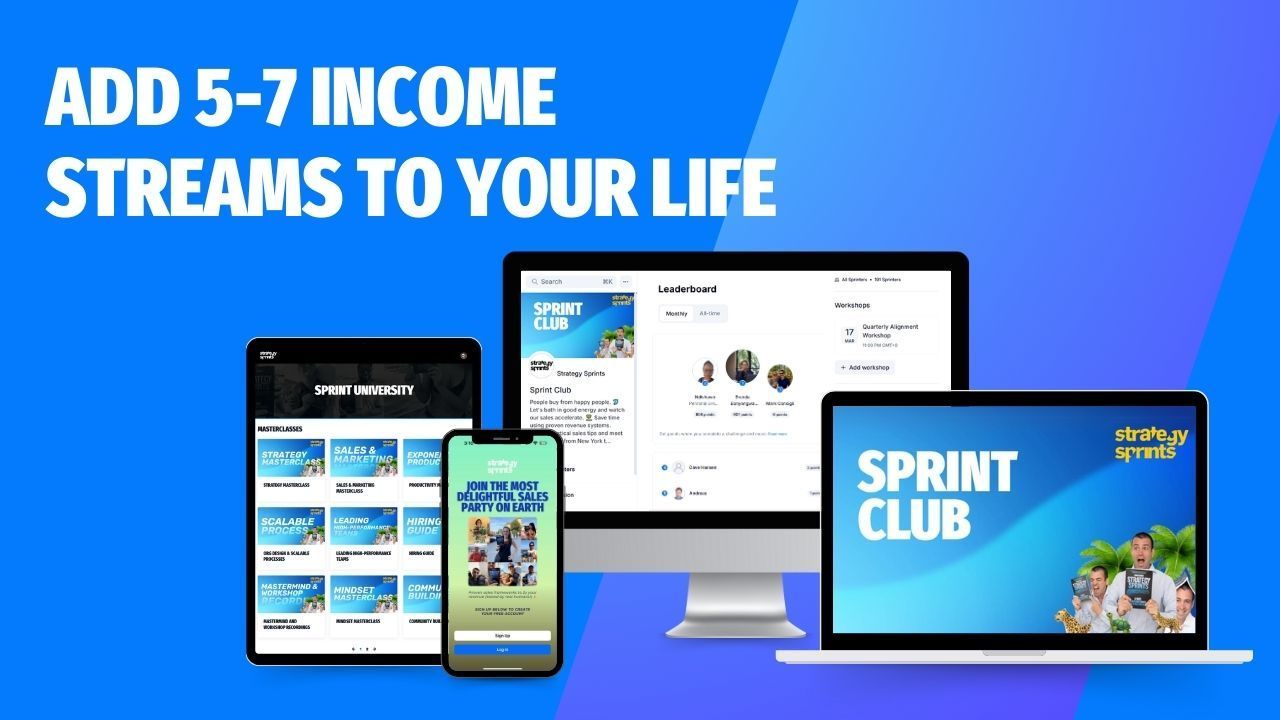
Want the tools, the AI skills and a community of founders who train like this? Join Sprint Club: https://www.strategysprints.com
Ready to accelerate now? Book a Discovery Call: https://calendly.com/strategysprint/discovery-call
Happy hunting.
Simon & The Sprinters 🐬⚡️🐆
Get our expert sales tips delivered
By submitting you agree to receive our weekly Strategy Sprints Newsletter as well as other promotional emails from Strategy Sprints. You may withdraw your consent at any time via the “Unsubscribe” link in any email or view our privacy policy at ant time.