Founder-Led Sales: Why a Weekly Cadence Beats More Effort
You didn't start the company to become the hunter.
Maybe corporate life didn't feel right. Maybe you wanted to travel, or be there for your kids. Then somewhere on the way it hits you: this is about sales. And the job description you wrote for yourself never mentioned it.
So you push harder. More hours, more follow-ups, one more tool. You're still the only one who closes. Evenings go. Weekends go.
You want revenue that grows and your evenings back. Both come from the same place. When effort stops working, the problem is structure: a few simple things, in the right order, every single week.
I talked this through with Marcos on Remembering the Forgotten (March 2026). Listen to the full conversation: Bounce Back to Presence on Remembering the Forgotten
Sales is the oxygen of your firm
Money, knowledge, time, relationships. You need all of them. But one is different.
"You can live without an HR department, but you cannot live without a sales pipeline or somebody selling."
If you're a one-person company, half your day is distribution and half is product. Two people? One sells, one builds. Sales isn't a department you add later. It's the oxygen.
Learn that late and it's expensive. Learn it early and you can still build prospecting and pipeline management calmly, before it hurts.
The commitment you made but never wrote down
🐬 I once opened a 200K Club session with one question, from 1 to 10: "How committed are you to being the sales engine of your company?"
We all make that commitment the day we start. Sure, I'll handle sales.
But we don't write it down. We don't put it in the calendar. "Tomorrow morning, two hours of prospecting." That line rarely makes it in.
Open tomorrow in your calendar. How many hours of prospecting are blocked? If the answer is zero, the gap isn't skill. It's a commitment that never became structure.
We learned this one with a bitter taste. One client left unhappy (the only three-star review we ever got). I sat down for 90 minutes with him and his sprint coach to find where we'd failed. One reason: we had assumed commitment. It's just a sales process, let's improve it. That assumption was ours. Today commitment is the first conversation, not an afterthought.
Weekly is the cadence that holds
I'm a weekly person. It shapes every client engagement.
Corporate clients used to ask for a bimonthly strategy meeting. I said no. Then monthly. "I don't do monthly strategy meetings." Their rhythm is fine. It's just not how I live, and not how sales moves.
A week is short enough to catch drift and long enough to finish something. So we run it as a loop. Monday Strategy: set the week, pick the one priority, block the prospecting hours. Friday Learnings: score it. What worked, what to double down on, what to drop. The week's win shows up in black and white.
Every Monday you're a slightly different person, and your market is a slightly different market. A weekly rhythm lets you adjust before the pipeline goes stale and small drift becomes a lost quarter.
Fix the process, swap the tools
🐯 This is where weeks disappear. Into techniques and software. A new CRM, a new AI tool, a new script.
Tools come and go. "The technique, the software, the tools in there will change." What stays is the process: getting attention, starting a conversation, nurturing the relationship, committing to work together, activating results, expanding from there.
Marcos put the alternative well. He calls himself a reformed executive coach, because teaching a process without real commitment behind it is like a bucket with ten holes. You patch three or four. The rest keep leaking every day.
Patching is reacting. Repairing is design. You repair by writing the process down once, in the right order, and running it every week until a new hire could run it without you. That's what the 8 Steps of the Repeatable Sale are for. One order, every conversation. You lead the call, the buyer says what matters to them, and nobody has to chase or beg for a yes.
Rewrite the thought that stops the call
Your calendar isn't the only thing that needs structure. So does the voice in your head.
The blocked prospecting hour arrives, and a thought shows up first. Too tired to send this email now. Don't prepare so much, just improvise. Every day brings a few of them. They come from old movies, old friends, people you still want to impress.
🐯 Here's one of mine. I was finishing my second book, Time Freedom, and asking for endorsements. There was one person I know from a mastermind whose number I had. I couldn't call. Something stopped me.
So I opened my vision document and added one sentence: "I powerfully ask for what I want." I read it aloud in the morning. In the afternoon, I called.
That's the exercise. Catch the thought that keeps you from the call, write down the opposite, and read it until you act on it. "We create our reality with our thoughts."
Your bounceback rate is a sales skill
🌴 In sales, things go wrong. Constantly. "In sales, it goes wrong intensely and it has to."
If one conversation in ten becomes a client, nine are supposed to be a no. That's math, not failure.
Roger Federer was once asked why he's so good. His answer: the bounceback rate. A big share of his shots don't land where he intends, so much of the time he's dealing with frustration. The skill is how fast he recovers.
Novak Djokovic describes his edge the same way. He catches himself being negative quickly and snaps back into the moment.
At the top, everyone trains hard. Same in your market. The difference is one question: "How quickly can you snap back to presence when things go wrong?"
You hear the no. Now the clock runs. A lost deal can cost you 20 minutes, 20 seconds, or two seconds. Go for two seconds. Treat it like a number you track.. it gets smaller when you know exactly why you're doing this.
A business that doesn't consume you
That's the real point of structure. A business that runs without swallowing the person who built it.
Here's the whole loop, in order:
- Commit. Rate yourself from 1 to 10 as the sales engine of your company. Write the number down.
- Block. Put the prospecting hours in the calendar on Monday, before anything else fills them.
- Lead. Run every conversation in the same order, so the buyer follows and you never chase.
- Rewrite. Catch the thought that stops the call. Write the opposite. Read it.
- Bounce back. A no costs you two seconds, not the afternoon.
- Score. Friday, black and white. Keep what worked, drop what didn't.
🌴 Run that every week and sales stops being the grind. It becomes the part you look forward to. And the time comes back. Prospecting on Tuesday morning, home for dinner on Tuesday night. That's Sprintlife: full intensity at work, fully present at home.
🐬 This week, do one thing. Before Monday, block two hours of prospecting for Tuesday morning. On Friday, score it. Did it happen? What came of it?
That's the loop. That's how you take control, one week at a time.
Listen to the full conversation with Marcos: Remembering the Forgotten with Simon Severino
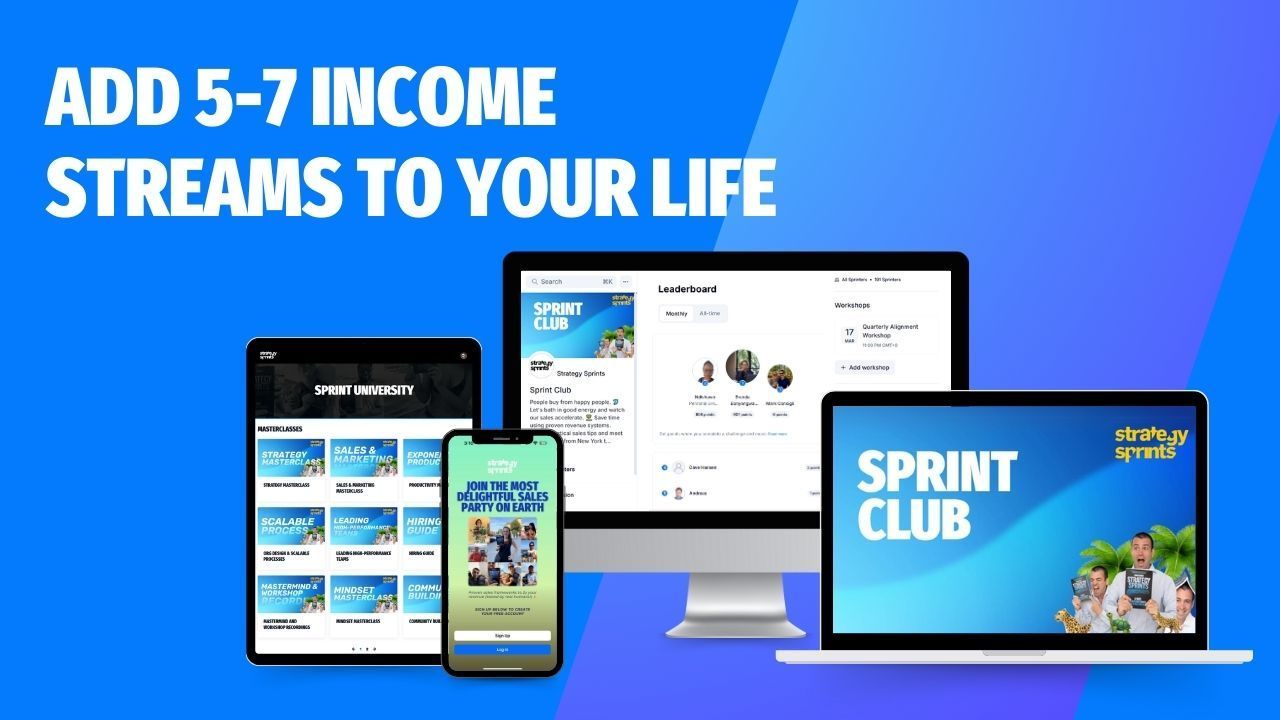
Grab the free tools and join the Sprint Club: https://www.strategysprints.com
Ready to accelerate now? Book a Discovery Call: https://calendly.com/strategysprint/discovery-call
Happy hunting.
Simon & The Sprinters 🐬⚡️🐆
Get our expert sales tips delivered
By submitting you agree to receive our weekly Strategy Sprints Newsletter as well as other promotional emails from Strategy Sprints. You may withdraw your consent at any time via the “Unsubscribe” link in any email or view our privacy policy at ant time.