High-Ticket Offers: Why Premium Sells When Budgets Tighten
Budgets are tight. Buyers take longer, ask more questions, and say "let me think about it" more often. The instinct is to make the offer cheaper, smaller, easier to say yes to.
That instinct points the wrong way.
On the show I put it in one line: "cheap products are harder to sell, expensive products are easier to sell." When money gets tight, the squeeze hits the low end first. The buyers who still have budget are buying, and they're buying quality.
I talked this through with Patrick Francey on The Everyday Millionaire Podcast (January 2025). Listen to the full conversation: Strategy Sprints: Design Your Desirable Future
The squeeze hits the cheap end first
The example I used on the show was a pool maker. Their CEO explained it on an earnings call: the cheap pools had a dry pipeline, while the high-end pools sold the same as always. Same company, same season, two completely different markets.
Our own sprints showed the same split. Low-ticket offers stalled. High-ticket professional services held up, because they are capital-light and carry higher margins.
So the question for a B2B founder isn't how to get cheaper. It's how to become the premium option your best buyers can trust.
🐬 In a squeezed market, the safest offer wins. Not the cheapest one.
A high-ticket sale is a trust sale
High ticket, the way we define it, is above $10,000. At that size there's complexity and risk, and the buyer carries two questions into every call. Why should I trust you? Does this really work for me?
A discount doesn't answer them. It makes them louder.
What answers them is control of the conversation. The 8 Steps of the Repeatable Sale, in order: let the buyer name the frustration, say how important it is, and put a number on what doing nothing costs, before you ever talk about the investment. By the time the price comes up, it sits next to their own number.
Month one: stop the false comparison
Most offers get compared with the wrong thing. A buyer lines you up against a cheaper tool, a freelancer, or doing nothing. On the show I called it what it is: "it's actually a false comparison."
Positioning fixes that. Say clearly who you're here to serve and what you help them accomplish, so the buyer compares you with the right alternative.
What we see when the positioning is refined: "you can increase your price now by 25 percent without losing clients." Sometimes more. That's the first milestone of a sprint, and it comes before any new marketing.
🐯 Bigger deals start with a clearer answer to "compared with what?"
Month two and three: win rate, then speed
We run it in a fixed order. "Month one is around positioning. Month two is around increasing win rates. Month three is around sales velocity."
Win rate: of every ten real conversations, how many close? Velocity: how fast does a deal move from first attention to a signature? Raise price, win rate and velocity by 25% each and they compound to roughly double the revenue.
The order matters. Push for speed with weak positioning and you just lose deals faster.
Pick one channel, and don't post alone
For B2B, most of our clients pick LinkedIn. One channel, every day, for the whole sprint, until it works.
Here's the part that makes it stick. Most founders are great at what they do and don't love marketing. So we put them in amplifier groups: about 20 founders with a similar target group who post together and keep each other accountable. Somebody notices when you skip a day.
Marketing turns from a chore into something you do with a team. That's when founders keep going long enough to see the leads.
Pay yourself first
I ask a couple of thousand entrepreneurs a year a simple question: what do you pay yourself every month? A lot of them don't know. Whatever is left at the end of the month is the salary.
That keeps you stuck in the business, and it creates "a very volatile very stressful life."
The fix is boring and it works. Pick a number. Move it from the company account to your personal account on the first of every month. Change the number any time, but install the system.
🌴 A founder who knows their own number sells from calm, not from need. The buyer feels the difference.
The habit under everything else
All of this runs on time you don't have yet. So the smallest habit is the one I'd start with, every day, two questions:
How did I allocate my time today? What will I delegate tomorrow?
Write the answers down. Hand one thing off the next day. "This is the core of surviving the next 10 years and of scaling a business." It's how I fired myself from operations: the process came out of my head, into a book, then into a method other coaches run.
Start this week
- One sentence. Write who you serve and what you help them accomplish. Ask: what does my buyer compare me with today?
- One call. On your next sales call, get to Step 4, Cost of Inaction, before you mention price.
- One channel. Pick it, post daily, and find two or three founders to post alongside you.
- One transfer. Set your salary as a fixed transfer on the first of the month.
- Two questions. Every evening: where did my time go, and what will I delegate tomorrow?
Picture the end of a quarter. Your offer is clearly the premium choice, your buyer named the cost of waiting before you named the price, and your salary landed on the first like clockwork. You have time to think again. That's Sprintlife: control of the sales conversation, and the time freedom it buys you.
Listen to the full conversation with Patrick Francey: Strategy Sprints: Design Your Desirable Future
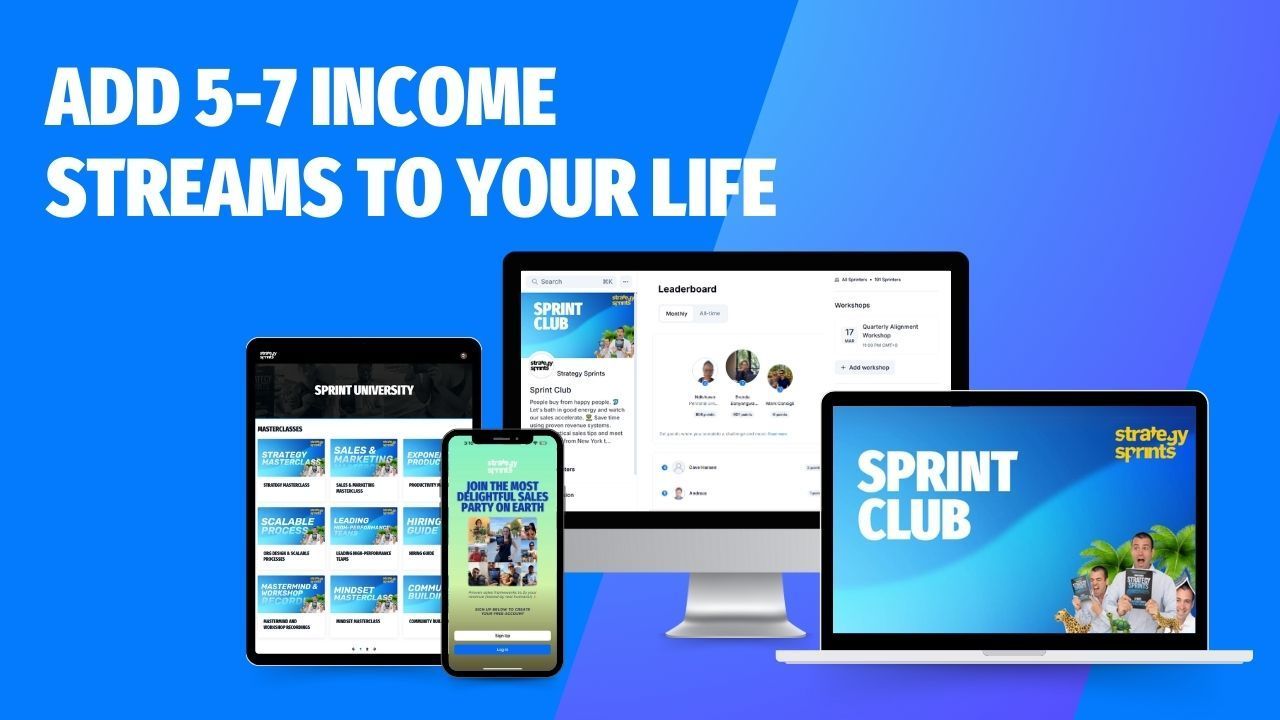
Grab the free tools and join the Sprint Club: https://www.strategysprints.com
Ready to accelerate now? Book a Discovery Call: https://calendly.com/strategysprint/discovery-call
Happy hunting.
Simon & The Sprinters 🐬⚡️🐆
Lead your next deal, first call to signature. 🌴
The 36 Sales Gaps Checklist: 36 places a deal dies, and the fix for each. Free, one page.
Free. You get the checklist, then more sales tools like it by email from Strategy Sprints. Leave in one click, any time.