Ideal Client Profile: Say No to 98% of the Market, Get Time Back
It's 9pm and you're still answering one client's emails. Rarely your biggest client. Usually the one who asks for the most and pays the least.
It looks like a time problem, so you fix the calendar. Earlier mornings, one more assistant, a better app. It rarely holds, because the leak started weeks earlier: the day you said yes to a client who was never a fit.
I talked this through with Mark Matteson on On Books and People (February 2026). Listen to the full conversation: Ep.119: Simon Severino
Saying yes to everyone feels safe. It isn't.
In the early years every client looks like survival. A no feels like turning money away. So you take the deal, then the next one, and slowly your calendar fills with people you can't really help.
Those clients cost far more than their invoice says. They take more meetings to close. They push on the price. They need you on every call. And they burn the energy you need for the clients you're best for.
There's a second cost, and it shows up in the sales conversation. When every deal feels like one you can't lose, the buyer can hear it in your voice. The proposal goes out before they've said what the problem costs them. The price drops the moment they hesitate. Control moves to the other side of the table.
Set the boundary first: who you're here to serve
On the show I said it plainly: "You decide who you are here to serve, and you do it very narrowly."
For me that's B2B founders with high-ticket services. Not sneakers. Not anything small you can put in a box. "I've already set a boundary that keeps 98% of the people out of my work."
98% sounds extreme. In practice it's the opposite. The 2% who fit get all of you: your best thinking, your full attention, and a process built for their world.
🐬 Fewer clients you can't help. More of your week for the ones you can.
A story from Time Freedom that stays with me
My new book, Time Freedom, has a chapter about Natasha. She and her husband ran a business together, and they never defined who they were not there to work with. The wrong people took much more of his time, his energy and his health. He was working too much with the wrong clients, and he had a heart attack. Natasha said not defining it literally killed him.
Most stories are less dramatic. The bitter part is the same. The wrong client gets paid for with your evenings, your weekends, your family and your health, long before anyone sees it in the numbers.
The exercise: five signs of yes, five signs of no
Take one page and draw a line down the middle.
On the left, write five things that tell you someone is your ideal client. Who they are, what they sell, how big the team is, how they make decisions, what they're ready to invest.
On the right, write five things that tell you they are not. The signals you've learned the hard way. For example: asks for a discount before the first call is over.
When one of the right-hand signals shows up, say a polite no, or refer them to someone who fits them better. You're not rejecting a person. You're protecting the clients you already have, and the hours you want back.
🐯 This is where the control comes back. When you know your no list, you walk into every call without needing the deal. The buyer feels it, and the conversation changes. You ask the questions. They answer. You're the one choosing.
Then delegate everything that isn't yours
The boundary is step one. Step two is delegation, which I called on the show the number one skill. Delegate to your team. Delegate to software. While Mark and I were talking, 17 AI agents were working on my monitor.
Mark shared a question he picked up years ago: "What's the best and highest use of my time?" Answer it honestly, and everything else becomes a task for someone, or something, that does it better.
Simple. Not easy. It means accepting what you're not great at, and letting go. Rowing with my kids taught me the team version of this: "You don't get faster if you just push harder. You only get faster if you align more with the others."
Keep the boundary alive: Monday and Friday
A boundary you set once goes stale within a month. The pipeline looks thin one week, a lead shows up who doesn't fit, and the old yes comes back.
So we check it every week. On Monday: "What's the most important thing to do this week?" On Friday: what worked, what didn't. Did I actually do it, or did I say I would and then do all these other things? The Friday score shows it in black and white.
The day I recorded with Mark, I asked the founders in our weekly group coaching for their most important activity of the week. Every one of them said prospecting. Then I asked how many prospecting calls they'd made. Zero. Simple things are hard to do every day without a rhythm, and without someone who asks.
That's what the weekly rhythm is for. "It's a continuous work of focusing on the one hand and of letting go on the other."
Start this week
If you only do one thing, do the page. The rest follows from it.
- One page, two columns. Five signs of your ideal client. Five signs of the client you'll politely send elsewhere.
- One honest look. Which current client hits two or more of your no signals? Count the hours they take from you every week.
- One thing off your desk. Pick one recurring task and hand it to a person, a tool or an AI agent by Friday.
- Monday and Friday. Monday: what's the most important thing this week? Friday: did I actually do it?
Picture a Friday a few months from now. Every client on your list is one you're glad to see in your inbox. Every sales call is with a founder you can really help, so you lead it calmly. You close the laptop at five, and nobody needs you until Monday. 🌴 That's Sprintlife: the freedom to live your life on your terms, and a business that funds it.
Listen to the full conversation with Mark Matteson: Ep.119: Simon Severino
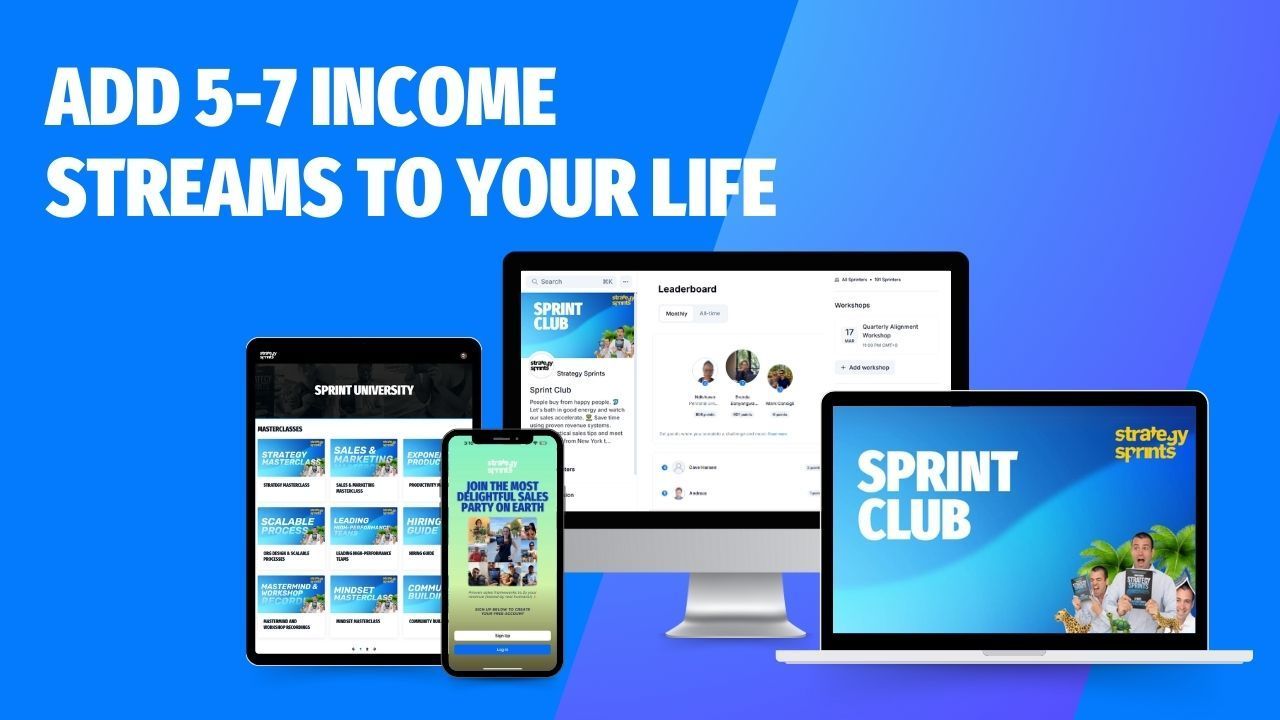
Grab the free tools and join the Sprint Club: https://www.strategysprints.com
Ready to accelerate now? Book a Discovery Call: https://calendly.com/strategysprint/discovery-call
Happy hunting.
Simon & The Sprinters 🐬⚡️🐆
Lead your next deal, first call to signature. 🌴
The 36 Sales Gaps Checklist: 36 places a deal dies, and the fix for each. Free, one page.
Free. You get the checklist, then more sales tools like it by email from Strategy Sprints. Leave in one click, any time.