How Do Weekly Sprints Work for Running a Business?
By Simon Severino, founder of Strategy Sprints, where 2,400+ B2B founders have gone through our programs. Updated November 2026.
A weekly sprint for running a business is a one-week loop with two fixed moments: on Monday you pick one priority and three outcomes you can count, and on Friday you score what actually happened and decide what to double down on and what to drop. Everything in between protects those outcomes. Thirteen loops make one 90-day sprint. 🐬
The week stops running you. You walk into Monday knowing what matters, and you walk out of Friday knowing what worked, in black and white. The plan lives on a page, not only in your head.. so your team can run it, and your weekend stays yours.
What is a weekly sprint in a business, if you are not a software team?
Software teams made the word popular. Scrum sprints, story points, daily stand-ups. The design sprint (the five-day format from GV) is something else again: one problem, one week, one prototype.
Neither was built for a founder who runs sales, delivery and a team at the same time.
A business sprint keeps the useful part: a short cycle with a fixed start and a hard review. No backlog grooming, no velocity charts. Three questions only. What are we doing this week? Why? Did it work?
At Strategy Sprints we call the two moments Monday Strategy and Friday Learnings. We run them inside our own company every week, and we teach them to every client.
How do you run Monday Strategy?
Thirty minutes. Same time every week. Pen, one page, a fresh start instead of last week's leftovers.
- Read the 90-day goal. One line, on top of the page.
- Read last Friday's learnings. What did you decide to double down on? What did you decide to drop?
- Pick one priority for the week. One. When everything matters, nothing moves.
- Write three outcomes you can count by Friday. "8 discovery calls held", not "work on pipeline".
- Give each outcome one owner. A name, not a team.
- Block the calendar. The priority gets time before email does.
Illustrative example: a founder hiring her first salesperson writes: Priority: the new hire can run a first call without me. Outcomes: the 8 Steps written on one page, 3 call recordings reviewed together, 1 call led by the hire while I listen. You can feel the difference already. It's like the early days of the company, when everyone knew the one thing that mattered this week. Friday will not be a debate. 🐯
What happens between Monday and Friday?
You hold the plan steady. You don't re-plan.
A ten-minute check on Wednesday is enough. Out loud, with the owners: are we on the way to the three numbers? If not, what's in the way? Remove the obstacle. Don't add a new goal.
New ideas go on a list for next Monday. That one list does the heavy lifting. Nothing new gets in mid-week unless it's a real fire, so the week feels calmer and the team stops hearing "quick change of plan" every Tuesday.
How do you run Friday Learnings?
Thirty minutes. You score, you don't defend.
- Each outcome: planned vs reached. Two numbers, side by side.
- What worked? Do more of it next week.
- What didn't? Stop it, or change one thing and test again.
- One win. Say it out loud, so the team hears you name it. Small counts.
- Next week's priority. Draft it now, while the lesson is fresh.
An illustrative Friday page for the founder above: 8 Steps on one page: done. Recordings reviewed: 2 of 3. Calls led by the hire: 0 of 1, the prospect moved the call. You see it, and next week's priority writes itself.
Blame the plan, never the person. "The plan was too big" gives you a better Monday. "You didn't deliver" gives you a quieter team.
After a few weeks you see the pattern: which work moves the numbers and which work only feels busy. 🌴
How long should a business sprint be: one week or 90 days?
Both. One sits inside the other.
90 days sets the direction. A quarter is long enough to change something real, like doubling revenue, landing your first sales hire, or fixing pricing.
One week drives the execution. A week is short enough to spot a mistake before it costs you a month.
So you set a 90-day goal, then run about thirteen weekly loops toward it. Each Friday tells you whether the quarter is still realistic. As a full program, here is what a 90-day growth sprint costs and what you get.
How do weekly sprints change sales?
Sales shows the loop fastest. The numbers are already there.
Good weekly outcomes in sales:
- New conversations started with the right founders
- Discovery calls held
- Calls that reached a start date (Step 7 of the 8 Steps of the Repeatable Sale)
- Statements of Work signed (Step 8)
The third line matters most. A call that ends with "send me a proposal" feels like progress and often isn't. The JOLT Effect research (Dixon & McKenna, 2022) found that 40-60% of qualified deals end in no decision. Scoring calls that reach Step 4 (Cost of Inaction) and Step 7 (Starting Date) shows you where your deals stall, every single Friday.
It's the same move as a good sales call. You lead, so you never end up chasing a buyer for an answer. That's control.
If you are hiring a salesperson right now, the weekly sprint is the handoff. Your new hire inherits a rhythm with clear numbers, not a head full of your habits. The sales version in detail: a good weekly sales routine for a founder-led B2B company.
What are the common mistakes with weekly sprints?
- Five priorities. That's a wish list. Pick one.
- Activities instead of outcomes. "Send emails" can't be scored. "12 replies" can.
- Skipping Friday after a bad week. It leaves a bitter taste, and it's exactly the Friday that teaches you the most.
- Re-planning on Tuesday. Put the new idea on Monday's list.
- Running it alone. A sprint without a spotter slowly turns into a to-do list. Someone outside your company who asks "what did the numbers say?" keeps it honest.
Skip the loop and the cost stays quiet: another month of full weeks with no score, and a new hire waiting for a plan that still lives in your head.
Your move this week: book 30 minutes next Monday and 30 minutes next Friday. One priority, three numbers, one score. Do it four weeks in a row before you judge it.
You don't have to run it alone. In our Sales Gym, every week you bring your three numbers, other founders bring theirs, and a spotter asks the question you'd rather skip. It's the rhythm at the center of our programs (2,400+ founders have gone through them), and it pushes you through your current sales wall. 🐬
FAQ
What is the difference between a weekly sprint and a weekly meeting?
A weekly meeting reports on what happened. A weekly sprint commits to three countable outcomes on Monday and scores them on Friday, so every week ends in a decision.
Do weekly sprints work for a small team of 3 to 10 people?
Yes. A small team needs even less: one page, one priority, one owner per outcome. No software needed.
How long should Monday Strategy and Friday Learnings take?
About 30 minutes each. If it takes longer, you are planning too much or arguing instead of scoring.
Can I run weekly sprints if my sales cycle is months long?
Yes. Score the steps that lead to a deal (conversations started, calls held, calls that reached a start date) instead of waiting for signatures.
What tools do I need for a weekly sprint?
A page and a calendar. A shared doc works once the team grows. The rhythm matters far more than the tool.
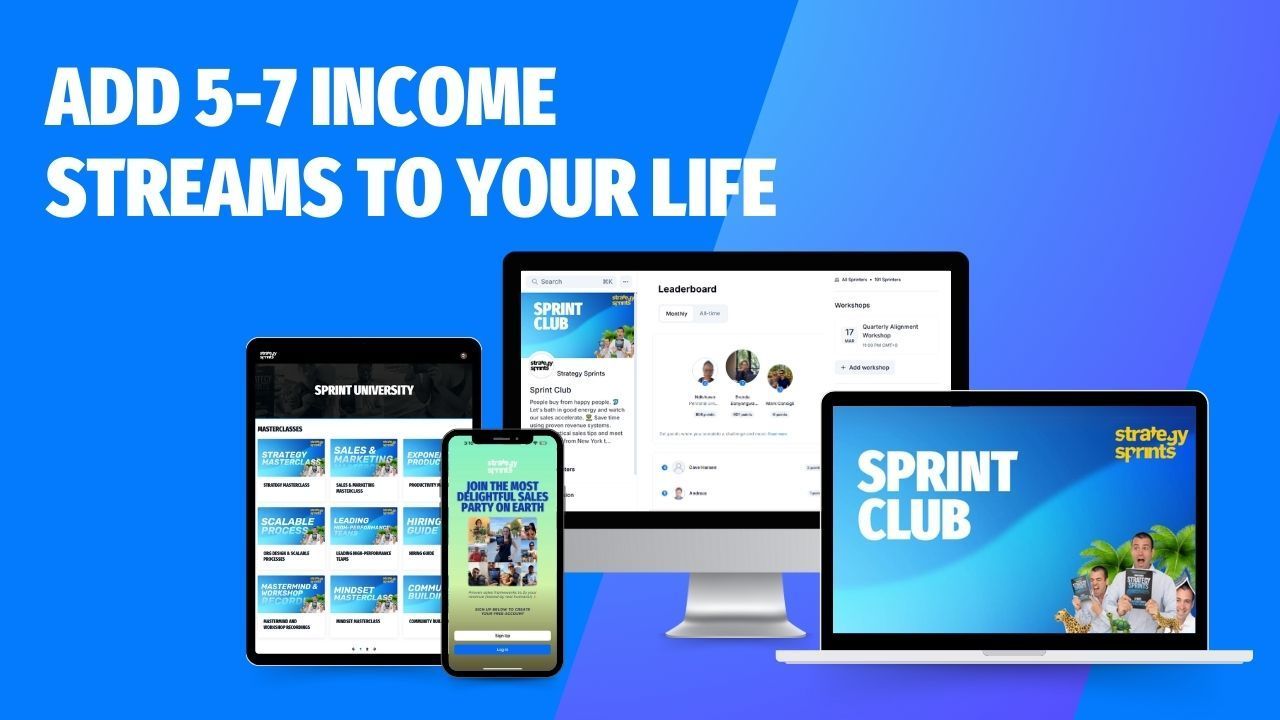
Want the tools and AI skills we use, with a community of founders doing the same work? Join Sprint Club, 7 days free: https://www.strategysprints.com
Ready to accelerate now? Book a Discovery Call: https://calendly.com/strategysprint/discovery-call
Happy hunting.
Simon & The Sprinters 🐬⚡️🐆
Lead your next deal, first call to signature. 🌴
The 36 Sales Gaps Checklist: 36 places a deal dies, and the fix for each. Free, one page.
Free. You get the checklist, then more sales tools like it by email from Strategy Sprints. Leave in one click, any time.