How to Use AI in B2B Sales Without Getting Ghosted
Your AI writes a follow-up in six seconds. 🐬
It summarizes a 90-minute call in two paragraphs. Clean. Confident. Professional.
And the deal still goes quiet.
You get ghosted, and you are still the one who has to close it.
Here's the trap: AI doesn't fix the order you sell in. It makes the wrong order faster.
In this article (and the full episode of The Sales Show) you get three things: why your AI sounds smart and still misses, where the real answers are hiding in your own calls, and the one rule for what to automate and when. The last one is the expensive one.
Why AI sales follow-ups still get you ghosted
Here's how AI gets used in most sales teams. You open a blank box. You type "write me a follow-up for this prospect." Copy, paste, send. Ask again tomorrow.
The answer looks great.. and then silence. The inbox stays quiet.
Why? Because the email went out before the buyer ever told you what doing nothing costs them.
We call this the cost of inaction. In the 8 Steps of the Repeatable Sale it's Step 4, and it's the step most people skip. 🐯
When nobody asked "what happens if you do nothing?", the AI has nothing real to work with. So it writes something polished and smart that misses the actual point.
It's the same reason deals take more meetings than they used to. Buyers are more careful. More people sign off. More scrutiny before a yes. A beautiful proposal sent too early doesn't speed that up. It hands the buyer one more document to forward to a committee you will never meet.
The tool isn't weak. The way it's being used is.
Why your AI sounds smart and still misses
I spent two decades in consulting, so here's the comparison that's been sitting with me: your AI is not a PhD. It's a junior consultant from McKinsey.
Drop that consultant into an industry they've never touched (healthcare, manufacturing). They prepare on the flight in. By the time they walk into your office, they sound like they've run the place for years. They get to 80% of anything, fast.
But 80% fast is not the same as right.
There's no scar tissue. They've never watched the exact deal die at the finish line. They've never heard the pause on the line when a buyer realizes the price is bigger than the problem they named. So they optimize confidently.. and sometimes they optimize the wrong thing.
That's your AI on a blank prompt. A brilliant consultant who has never met your buyers.
So ask yourself one question: what does your AI actually know about the last 10 deals you lost?
If the answer is nothing, that's the gap. Not the model.
What your AI sales stack is missing: your calls
Models are a commodity. They get cheaper every quarter. Next year there'll be a new one, and the year after another one.
Betting your edge on which model you use is like betting your edge on which brand of hammer you own. 🌴
What doesn't get cheaper is your data: how your business actually sells.
That's what we build with founders in our mastermind. You map your sales process as a digital twin, what we call an ontology. Philosophers coined the term; Palantir made it famous by building ontologies as the foundation for AI that helps companies run the actual business.
For a sales team it means one connected place with every sales call, every follow-up, every objection, every word your buyers use. Without it, plugging AI into anything gives you slop.
With it, the machine starts seeing things you'd never catch on your own, because it now has a model of your reality that's more precise than the one in your head.
That's where you get sharper. That's where your follow-up emails get better.
Now run the 8 steps on top of it: Visualize, Frustration, Importance, Cost of Inaction, Deliverables, Investment, Starting Date, Statement of Work. Every step is grounded in the buyer's reality, and your picture of their situation is sharper than the one they walked in with.
And the buyer goes: "Holy cow. I feel seen, understood. I need you on this. Let's start working."
Order matters as much as data. Every week I get five to seven recordings of sales calls. Sometimes people do the wrong things. Sometimes they do the right things in the wrong order. Change the order, and you change how you sell.
When that works, add AI and it's like having six arms instead of two. It's still you, your expertise and your experience. AI doesn't have experience. It predicts the next word.
Automate last: fix your B2B sales process first
AI makes automation cheap, so automation becomes the reflex. See a task, automate it. I've done it myself.
Elon Musk runs his companies on a five-step sequence he calls the algorithm, and the order is the whole point:
- Question every requirement. Who asked for this step? Is it really a must?
- Delete it. Cut every step you can.
- Simplify what's left.
- Accelerate. This is the first step where AI comes in.
- Automate. Only now.
Automation is last for a reason. You slow down to speed up. And I say that as a sprinter.. we don't slow down for the sake of it. We slow down so we can accelerate.
Do it the other way around and you're just accelerating chaos. 🐯
That's the difference between AI that pays you back and the general slop you're seeing (and maybe even receiving) from AI.
When you get ghosted, it usually means a step got skipped: Importance, Cost of Inaction or Frustration. Whatever you send afterwards doesn't hit exactly what they need.
That's why we train these eight steps with CEOs every single week, for 12 months. Some of them have already closed deals of $2,200,000, $150,000, $130,000. They still practice. Like Ronaldo.. he knows how to use his legs, and he still trains legs every day, one isolated part of the movement at a time.
Your one move: 5 lost deals, one afternoon
Here's the exercise for this week.
Take your last five lost deals. Five.
Pull every transcript, every email, every note you have about those deals. Put them in one place.
Then ask your AI (we use Claude Code; use whatever works for you, just pick one and go deep): "In which of these calls did the buyer say what doing nothing would cost them?"
My guess: you'll see the pattern in one afternoon.
That's the first piece of your own small digital twin. Small, specific, clean data, fresh from your own calls. Nobody else has it in their AI.
Then fix it on the next call. Ask: "What happens if you do nothing?"
On Friday, score it. How many calls got better? That's your Friday scorecard. Watch your win rate climb week over week.. and watch what it does to your team's confidence.
Confidence doesn't come from manifesting. It comes from "I had this problem, I improved one small thing by 2%, and I saw it get better." Small experiments gone right that become habits.
And when your sales get that clear, you get your weekends back. You fall in love with your business again. That's Sprintlife. 🐬
Watch the full episode: https://www.youtube.com/watch?v=uQbQrvsUPpk
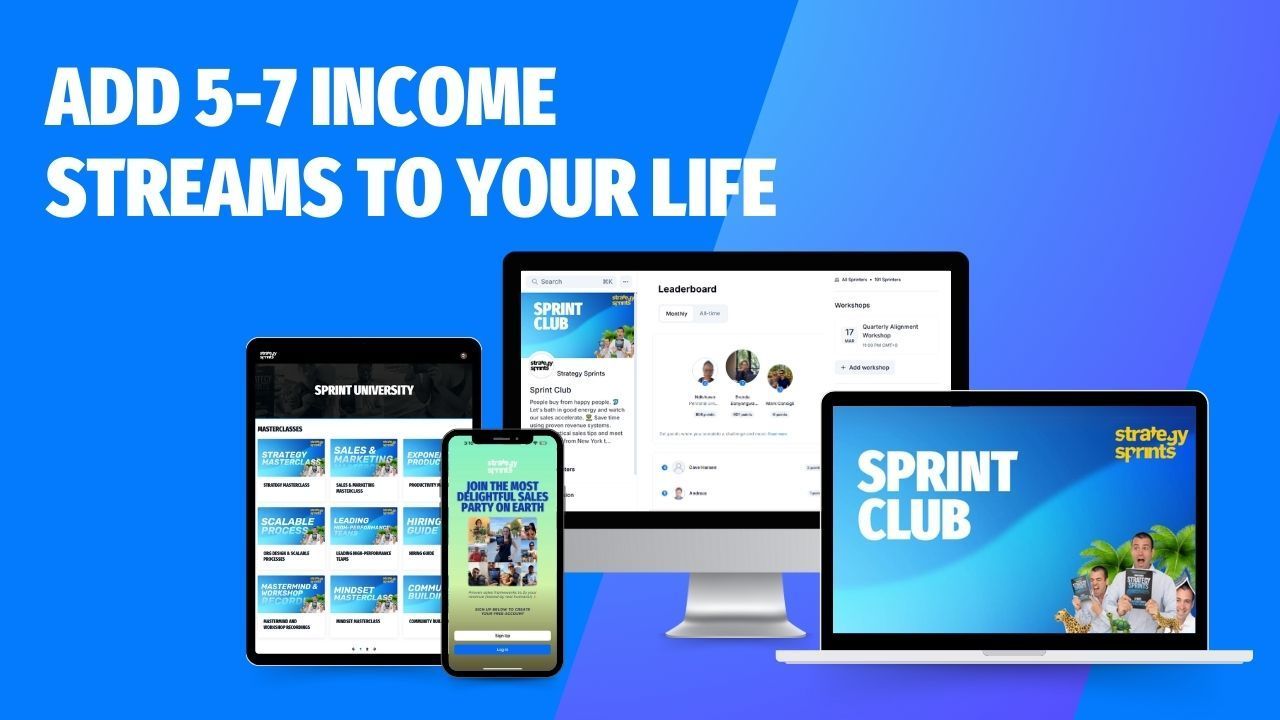
Want the 8-step sales process, plus spotters who push you through your current sales wall? Start Sprint Club free for 7 days: https://www.strategysprints.com
Ready to accelerate now? Book a Discovery Call: https://calendly.com/strategysprint/discovery-call
Happy hunting.
Simon & The Sprinters 🐬⚡️🐆
Lead your next deal, first call to signature. 🌴
The 36 Sales Gaps Checklist: 36 places a deal dies, and the fix for each. Free, one page.
Free. You get the checklist, then more sales tools like it by email from Strategy Sprints. Leave in one click, any time.