What Is a Sales Gym? How Founders Train Sales Like Athletes
By Simon Severino, founder of Strategy Sprints, where 2,400+ B2B founders have gone through our programs. Updated November 2026.
A sales gym is a place where founders and salespeople train the sales conversation the way athletes train: the same moves, in the same order, repeated on real deals, with spotters who push you through your current wall. It isn't a course you watch. It's reps. The result: you lead the call instead of chasing the buyer, and you stop being the only closer. 🐬
What changes when it works: you stop hoping a call goes well. You know what happens next, because you've trained that exact moment on real deals. Closing gets fun again, and bigger deals land at your price. A new sales hire can run the same moves without you on the call.
What is a sales gym, exactly?
If you train for anything, you already know this. Nobody gets stronger reading about deadlifts. You lift, someone checks your form, you add weight next week.
A sales gym works the same way. It has three parts:
- Tools. Scripts, question lists, a Statement of Work template, a weekly scorecard. The equipment.
- Processes. A fixed order of moves for every sales conversation. The training plan.
- Spotters. People who watch your reps, catch the bad habit, and push you through the next wall. The coach next to the bench.
Most "sales gym" content online means role-play: reps practice objections on each other or on an AI buyer. That's useful. But role-play on made-up scenarios is the warm-up, not the workout. The real reps happen on your live pipeline, this week.
Why do founders need a sales gym, not more sales training?
Because the hard part of selling is staying in control when it counts, and knowledge alone doesn't get you there.
Picture the call with the buyer you really want. The books said "ask, then listen." But the old pattern is stronger: pitch early, send the proposal fast, chase after the call. 🐯
Under pressure, people don't rise to the level of their knowledge. They fall to the level of their reps.
Without the reps, every big call stays a coin flip. And you stay the only person in the company who can close.
Classic sales training gives you a day of input and then leaves. A gym is weekly. Same moves, real deals, feedback within days, not months. That's how the old pattern gets replaced instead of just explained.
It matters more right now, because buyers hesitate longer. The JOLT Effect research (Dixon & McKenna, 2022) found 40-60% of qualified deals end in no decision. Most of those deals aren't lost to a competitor. They go stale, quietly, in the inbox. A trained seller notices the drift in the call and leads the buyer to a decision.
What do you actually train in a sales gym?
The moves of the sales conversation, in order. In our gym that's the 8 Steps of the Repeatable Sale:
- Visualize. Picture what the buyer says, mirror their last words, match their pace, then lead.
- Frustration. "What's the frustration? What have you already tried?"
- Importance. "How important is this, in the context of everything else going on?"
- Cost of Inaction. "What happens if you do nothing?" Then silence.
- Deliverables. "What do you want to achieve in the next 10 days?"
- Investment. Time, people, then money. In that order.
- Starting Date. "To which starting date are we committing?"
- Statement of Work. Sent before the next meeting, written in the buyer's words.
Each step is a rep. You can train one at a time, like one muscle group. A week on Step 4 alone (asking the question, then holding five seconds of silence) often moves a stuck deal more than any new tactic. Here's a deep dive on the cost of inaction question.
The order is the point. Stalled deals usually come from the right things done in the wrong order: price before cost, proposal before start date.
What does a spotter do in a sales gym?
A spotter stands next to you when the weight gets heavy.
In sales, the heavy moment is specific. The buyer says "send me a proposal." The buyer says "it's too expensive." The line goes quiet and you hear your own pulse. That's where you fall back into the old habit, and that's where a spotter helps:
- Before the call: "Which step is this deal on? What's the one question you'll ask?"
- After the call: "Where did you lose control? What did the buyer say, word for word?"
- On the stuck deal: "You sent the proposal before Step 7. Go back and get a start date."
A good spotter doesn't do the lift for you. They make sure you finish it yourself. That's the difference from a consultant who closes the deal for you and leaves you exactly where you were. 🌴
How do you set up a sales gym in your own company?
You can start this week, with your team of one or ten. Four pieces:
- Pick the moves. Write down your call order. Use the 8 Steps or your own, but fix the order.
- Train on real deals. Every week, pick two live deals. Before each call, name the step and the one question. After, write what the buyer said.
- Set a rhythm. Monday Strategy: which deals, which step, which move. Friday Learnings: score the week. Where did you lead? Where did you chase?
- Get a spotter. A peer, a coach, a group of founders who do the same reps. Someone outside your own head.
Picture the Friday review. Three deals on the list. Next to each: the step it reached and the buyer's exact words. One deal says "Step 4, buyer said: 'if this doesn't work, I'm the only closer again next year.'" That's a deal with a real reason to move, and you can taste the difference. The empty ones tell you where to train next week.
Can a new sales hire train in the same gym?
Yes, and this is where the gym pays off most.
When you hire your first salesperson, the process usually lives in your head. You close by instinct. Your new hire can't copy instinct. They can copy moves.
So the hire trains the same 8 Steps, on the same scorecard, in the same Monday and Friday rhythm. You become their spotter for the first weeks. Then the gym runs without you on every call. That's how you stop being the only closer. More on that hand-over: the 8 steps a new hire can run.
At Strategy Sprints we open up our Sales Gym to founders and their sales teams: our tools, our processes and our spotters, on live deals. In the 200K Club, a group of 5 founders trains together on a weekly live call, with a coach on call in the app between calls. Before Strategy Sprints, I coached 2,000+ teams, including Google, BMW and Airbus. 🐯
Your one move this week: pick one live deal, name the step it's on, and write down the one question you'll ask on the next call.
FAQ
What is a sales gym? A training setup where you practice the sales conversation on real deals, in a fixed order of moves, with spotters who give feedback. The goal is control of the call.
Is a sales gym the same as sales role-play? Role-play is one exercise inside a gym. A full sales gym adds a fixed process, weekly reps on live deals and a spotter who reviews them.
How often should you train in a sales gym? Weekly. Set the deals and moves on Monday, score what happened on Friday, and pick the next rep from what you learned.
Who is a sales gym for? Founders who still close most deals themselves, and sales teams that need one repeatable way to run a call, especially new hires. It's not for anyone looking for a one-day motivation event.
What is a sales spotter? Someone who watches your sales reps, catches the habit that costs you control, and pushes you to finish the move yourself on the next call.
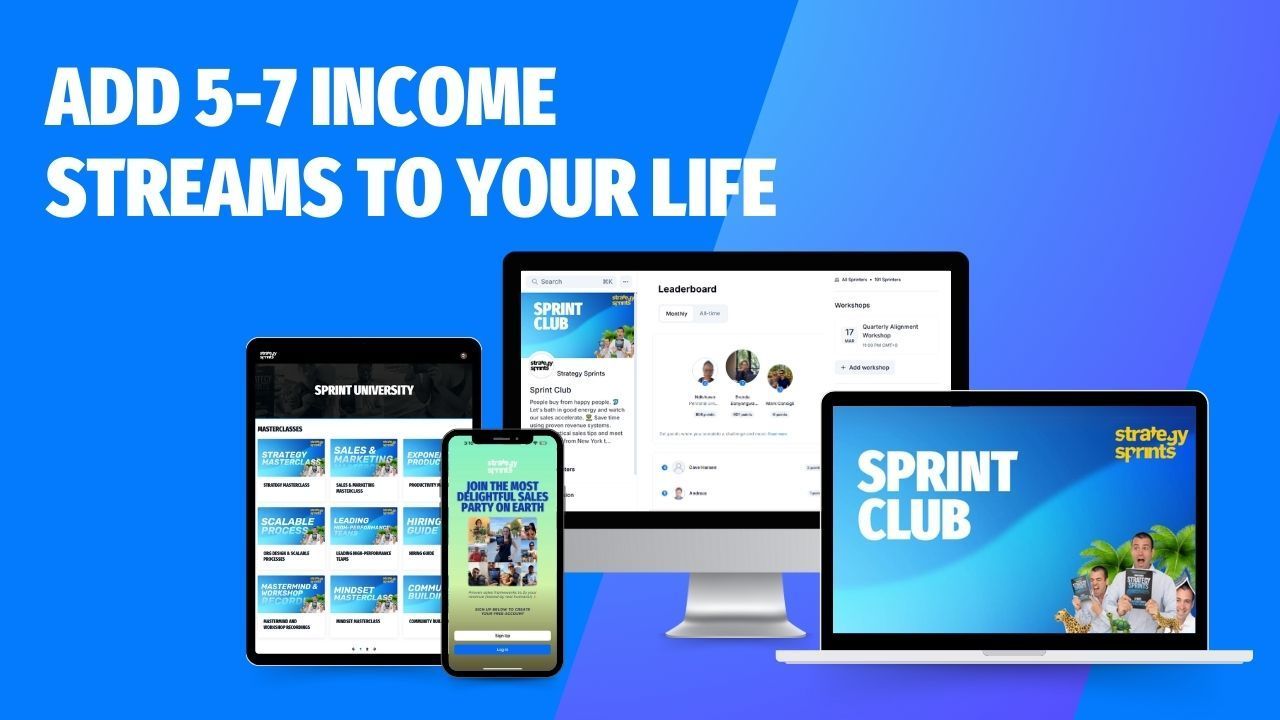
Want the tools and AI skills we use, with founders doing the same reps? Join Sprint Club, 7 days free: https://www.strategysprints.com
Ready to accelerate now? Book a Discovery Call: https://calendly.com/strategysprint/discovery-call
Happy hunting.
Simon & The Sprinters 🐬⚡️🐆
Lead your next deal, first call to signature. 🌴
The 36 Sales Gaps Checklist: 36 places a deal dies, and the fix for each. Free, one page.
Free. You get the checklist, then more sales tools like it by email from Strategy Sprints. Leave in one click, any time.