Allowing Yourself to Win: The B2B Sales Framework for a World That Changes Every Six Hours
How does the OODA loop apply to B2B sales?
The OODA loop (Observe, Orient, Decide, Act) comes from fighter pilot John Boyd. In sales it means the seller who reads the buyer most accurately wins, not the one who talks fastest. You build that read by treating every lost deal as data: ask "what did I misread?" before "what did they miss?" Keep your direction fixed, adapt the tactics, and you stay in control of the call. 🐯
Updated October 2026
Your Q1 sales plan was obsolete before you finished writing it.
Not because you planned badly. Because the environment your plan was designed for changed three times while you were writing it. A competitor dropped their price. LinkedIn's algorithm shifted. Your top prospect got acquired. The buyer who said "call me in January" is now reporting to someone else.
This is not a planning problem. This is a time problem.
John Boyd figured this out in fighter jets traveling at 1,000 miles per hour. His insight, applied to business by Chet Richards in Certain to Win, is the sharpest competitive framework for B2B sales that most founders have never encountered.
Boyd called his framework the OODA loop: Observe, Orient, Decide, Act.
Here is what most people miss about it: the OODA loop is not about speed. It is about orientation, your accumulated mental model of what is actually happening in the room, in the market, with this specific buyer. The side with better orientation wins even when it moves slower. In sales, the person who reads the prospect most accurately, not the one who talks fastest, closes more.
Speed is a byproduct. Orientation is the cause.
The Problem With Your Sales Process
Most B2B sales processes are built like annual plans, rigid, sequential, designed for an environment that no longer exists by the time you're using them.
You built a sequence. It worked last year. Now it's returning 20% of what it used to. You add more steps. You try a different script. Nothing shifts.
The issue isn't your script. It's your cycle time.
Richards writes: "Strategy is a mental tapestry of changing intentions for harmonizing and focusing our efforts as a basis for realizing some aim or purpose in an unfolding and often unforeseen world of many bewildering events and many contending interests."
Read that again: changing intentions. Not fixed ones. Not committed ones. Changing.
A strategy that cannot change is not a strategy. It's a plan. And in a world that changes every six hours, plans are monuments to the past.
What Boyd Actually Discovered
Boyd studied why certain pilots kept winning dogfights they had no business winning, smaller aircraft, less fuel, worse position. His answer: they didn't win by being better. They won by making their opponent wrong faster than their opponent could recover.
The same dynamic plays out in every B2B sales conversation.
Your prospect enters the call with a mental model of what they need, what it should cost, and who should provide it. Your job is not to confirm that model. Your job is to update it faster than anyone else can, and to do it in a way that feels like clarity, not pressure.
Richards puts it cleanly: "Successful businesses don't concentrate on affecting competitors but on enticing customers."
This breaks the entire "attack your competitor's weaknesses" playbook. You are not in a battle with your competitor. You are in a conversation with a human being who has problems, fears, and a picture of what success looks like. The competitor becomes irrelevant the moment you frame the conversation around criteria they are not designed to win on.
Bad News Is the Only News That Helps You
Here is where Boyd's thinking gets uncomfortable.
In B2B sales, your orientation, your accumulated understanding of the market, the buyer, the problem, is your primary asset. Not your deck. Not your pricing. Your orientation.
And orientation degrades the moment you stop testing it against reality.
Richards is direct: "Since what you're looking for is mismatches... a general rule is that bad news is the only kind that will do you any good."
When a prospect goes cold, that's data. When your close rate drops, that's data. When a deal you were certain about goes to a competitor, that is the most valuable information you will receive this quarter.
Most sales organizations suppress bad news. They rationalize. They blame the prospect's budget cycle. They move to the next name on the list.
Boyd's system demands the opposite: treat every lost deal as a correction to your mental model. Not a failure. A calibration.
The founder who builds this habit, who debriefs every loss without ego, who asks "what did I misread?" before "what did they miss?", develops something money cannot buy: accurate orientation. Over time, their read of a room becomes uncanny. They seem to know which deals will close before the prospect does.
They don't have a gift. They have a system for absorbing bad news.
The Four Things That Actually Build a Winning Sales Culture
Boyd extracted four principles from the military organizations that maintained performance under chaos. Richards calls them the four German words. They translate directly to B2B sales.
Einheit (Mutual Trust). "People climb out of warm, safe foxholes, after all, to face bullets because they won't abandon their comrades." In sales, Einheit is the trust between you and your prospect. They move forward not because your pitch was perfect but because they believe you will deliver. That trust accumulates across every touchpoint: the first email that doesn't oversell, the follow-up that arrives when you said it would, the meeting that ends exactly on time.
Fingerspitzengefühl (Intuitive Feel). Translated literally: "fingertip feeling." The ability to catch a shift in a prospect's tone, a fractional pause, a change in posture, a single word that wasn't in the brief, and adjust without stopping to analyze. This cannot be scripted. It is built through volume, honest reflection, and someone in the room willing to tell you the truth after the call.
Auftragstaktik (Mission Over Micromanagement). This is the principle that quietly destroys most scaling sales organizations. As headcount grows, the founder tightens control. Every email goes through approval. Cycle time collapses. Prospects wait three days for answers that should take thirty minutes. Auftragstaktik means your team knows the mission so completely they can make the right call without asking. You define the destination. They choose the route.
Schwerpunkt (Focus). In sales, Schwerpunkt is the answer to: what is the one thing this quarter that, if achieved, makes everything else easier? Not five priorities. One. Without it, you have eight people pointing in six directions and calling it an aligned team.
Shape the Conversation, Not the Competition
The instinct most of us develop, tracking competitors, watching their pricing, monitoring their positioning, is understandable. It is also almost always a distraction.
Richards frames it directly: "Shape the battlefield rather than beat the competition. Improve capacity for independent action, to survive on own terms."
Shaping the conversation in B2B sales means: you determine the criteria on which the decision gets made. You arrive at the discovery call having already done the prospect's homework. You name the problem before they do. You surface the cost of inaction before they've calculated it. You propose the decision process before they've invented one.
None of this requires mentioning a competitor. By the time the other options enter the picture, the conversation is already structured around criteria designed to highlight what you do, and what they don't.
The Risk Calculation Nobody Teaches You
"If you achieved a 97% chance of winning a fight, which would be spectacular against people who train just as hard as you do, your odds of surviving 25 fights is less than 50%."
The implication for pipeline management: volume without selection is not a strategy. It is slow-motion attrition.
The founders who build durable revenue are not those who take the most shots. They are those who have developed the orientation to know, before they invest serious time, whether they can get to something close to certainty.
This is not selectivity as an excuse for inaction. It is honesty. If you cannot identify the three reasons this specific prospect is buying, the two alternatives they're weighing, and the one internal champion who will push the decision through, you are not in a deal. You are in a conversation that feels like one.
With the right orientation, you can become more selective and increase your close rate at the same time. The deals you enter become the deals you win. You stop measuring activity. You start measuring signal.
Allowing Yourself to Win
The founders who run fixed plans in changing environments are not bad strategists. They are unconsciously protecting themselves from a particular kind of discomfort: the feeling that changing course means the previous course was wrong.
Boyd's framework offers a different operating stance. You don't commit to a plan. You commit to a direction.
The strategy is stable. The tactics adapt. Every six hours, if necessary.
In B2B sales, this is a team that holds the relationship constant while adapting the offer, the timing, the format, the entry point. That does not pivot to a different market when a deal stalls, but does change its angle without losing the thread. That holds its ground on price while adjusting what's inside the proposal.
That is what your prospect is waiting for. Not a better ROI slide. An idea that reorganizes their thinking about what is possible, delivered by a founder who is clearly in control of their own process.
The founders who operate this way are rare. They do not close deals through pressure. They close them by making inaction feel more expensive than moving forward. They win by cycling through orientation and action faster than doubt can accumulate.
Allow yourself to be that founder. That is how you become certain to win.
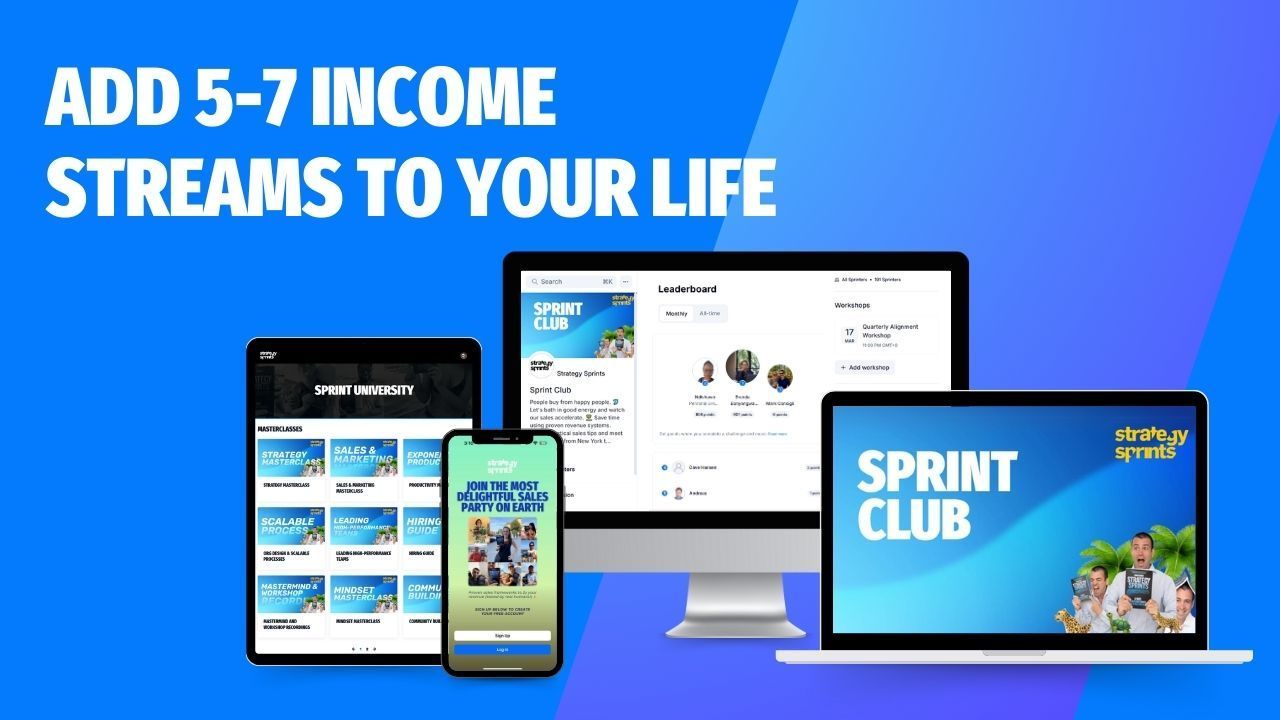
Every week inside the Sprint Club, we run one live scenario: a real B2B sales situation, a structured debrief, one calibration. Founders who do this consistently report that their close rate shifts within 90 days, not because they changed their pitch, but because they changed how fast they read a room.
Start your free 7-day trial: https://www.strategysprints.com
Happy hunting. Simon & The Sprinters 🐬⚡️🐆
Lead your next deal, first call to signature. 🌴
The 36 Sales Gaps Checklist: 36 places a deal dies, and the fix for each. Free, one page.
Free. You get the checklist, then more sales tools like it by email from Strategy Sprints. Leave in one click, any time.