B2B Sales Strategy: How to Land 84 Deals and Make $1M a Year
A B2B sales strategy starts from the number, not the activity. Divide your revenue goal by your average deal size to get the deals you need (a $1M year at $12,000 per deal is 84 deals, 7 a month). Divide by your win rate to get meetings (35 a month at 20%, about 2 a day). Then fill each day with four sales activities, hot conversations first.
"Simon, should I send more LinkedIn messages?"
"Simon, should I pay for email addresses?"
"Simon, should I pay for ads?"
Those were the questions in our last masterminds. Good questions. All about activity. 🐬
The bigger question sits underneath: how do you get a much bigger year without giving up your evenings for it?
Starting with activity won't get you there. It's how good people end up doing the right things in the wrong order. Same effort, same pipeline, same number as last year.
So we go the other way around. A million dollars becomes 84 deals. 84 deals become two meetings a day. Two meetings become four things you do every morning.
And the order of those four matters more than anything. One hot conversation is worth about 25 cold ones. 🌴
In about ten minutes you'll know exactly what tomorrow morning looks like. And how to lead those conversations instead of chasing them.
Watch the full video here: https://www.youtube.com/watch?v=d7owG3e4xVk
Step 1: Start from your number
A million sounds big. Until you break it down.
Most founders in our Sprint Club are shooting for one million, so that's the example here. But the process doesn't care about the size of the number. It's the same math if you're hunting for $200,000 or $200 million. Scale it down, scale it up.
Grab a pen. Write your number at the top of a page. Your number for 2027, not someone else's. 🐯
Step 2: Turn the number into deals
Now divide.
If your average deal is $12,000, you need 84 deals to make a million.
84 deals a year is 7 deals a month.
7 deals at $12,000 is $84,000 a month. That's your million.
| The plan | Number |
|---|---|
| Revenue goal | $1,000,000 a year |
| Average deal size | $12,000 |
| Deals per year | 84 |
| Deals per month | 7 |
| Revenue per month | $84,000 |
A million is a dream. Seven deals a month is a target you can track every Friday.
Step 3: Turn deals into meetings
Seven deals is an outcome. But what's the input? What do you have to create to actually get there?
Meetings. And how many meetings it takes depends on your win rate.
If you know your win rate, use it. If you don't, take a conservative 20%. One in five meetings becomes a client.
To win 7 deals a month at 20%, you need 35 new meetings a month.
With about 20 working days, that's less than two new meetings a day. Call it two a day. Now you have a buffer for the weeks where life happens.
And life always happens. I have kids, and we operate across several countries. There's always something in between. So plan with a buffer. Plan conservatively. 🌴
Here's the whole plan on one line:
Two new meetings a day. 20% win rate. $12,000 average deal. 7 wins a month. $1 million a year.
Say it out loud once. It sounds like someone who runs the business, instead of the business running them.
Then write your own version. Your deal size, your win rate. The moment you see it on paper, the million stops being a dream and becomes a math problem. And math problems get solved.
Change one lever and the daily work changes
Your numbers are different? The plan still works. It just shows you which lever matters most.
| If this changes | What you need instead |
|---|---|
| Win rate drops to 10% | 70 meetings a month for the same 7 deals |
| Average deal grows to $25,000 | Just 40 deals a year, about 3 a month |
| Win rate stays at 20%, deal stays at $12,000 | 35 meetings a month, about 2 a day |
A lower win rate doubles the meetings you need. A bigger deal cuts the deals you need by more than half. Every lever changes what you do between Monday and Friday. That's why you plan first, and only then pick your activities. 🐬
Step 4: Work backwards to your top four
Now let's turn that plan into daily activities.
Two new meetings a day doesn't happen by hoping. Hope is not a strategy. You need a plan, and you need execution.
Here's what I do, and what our clients do. Every morning I write down my top four. Four actions that bring me closer to a yes, closer to one landed deal.
Then I start doing them.
Not the inbox first. Not Instagram first. The four.
Then I track them. Every day, each of the four gets a tick, or it doesn't. No feeling busy, no guessing. I see the streaks, and I reflect on what's easy and what's hard.
When something keeps not getting a tick, I don't blame my willpower. I change my environment: my desk, my day, my calendar, until it supports the four instead of fighting them. And every week I sit with peers and we say honestly where it's hard and where it's easy, and we learn from each other. 🐯
Without the ticks, the million is a pipe dream. With four ticked activities a day, it's a plan you're executing.
Monday Strategy and Friday Learnings
On Monday, I set the week. On Friday, I score it.
We call it Monday Strategy and Friday Learnings.
Monday is the intention. Friday is the truth. And the next Monday starts fresh, better because of it.
Your Friday question is simple: did my four create the meetings this week? If yes, keep going. If not, Monday changes the four.
And when you hire your next salesperson, this rhythm is what you hand them. A number, four activities, a Friday score. Simple enough to run when you're not in the room.
Step 5: Pick your four from the menu
Here's the big question. Which four?
Because not all sales activities are equal. Not even close.
Many of our one-on-one clients ask us for examples so they can start faster. So here's the menu I show them. Three kinds of conversations, three very different conversion rates.
| Conversation | Converts at | Examples | Daily volume for the meetings |
|---|---|---|---|
| 🔥 Hot | 12% | Referrals, past clients, past registrants | 5 a day create about 3 meetings a week |
| 🌴 Warm | 3% | Subscribers, commenters, hand raisers, LinkedIn profile visitors, downloaders | 20 a day create about 3 meetings a week |
| 🐬 Cold | 0.5% | Cold calls, cold email, sending gifts | 200 a day create about 5 meetings a week |
Read the right column again.
Five hot conversations a day get you about as many meetings as twenty warm ones. Cold needs two hundred a day to create five.
One hot conversation is worth about 25 cold ones. Chew on that for a second.
You see the lever getting smaller as you go down the table, right?
What counts as hot, warm and cold
Hot = people who already trust you or already raised their hand with you. A referral someone just made. A past client. Someone who registered for your event. A deal that went quiet. A proposal that's been sitting there for ten days.
Warm = people who know you, but you're not in a buying conversation yet. They subscribe to your newsletter. They comment on your posts. They raised their hand on a poll. They viewed your LinkedIn profile. They downloaded your checklist.
Cold = people who have never heard of you. Cold calls, cold emails, gifts sent to strangers.
Why you start hot, every time
I've been a sales coach for 23 years. My recommendation never changes: start with the hot levers.
If the hot ones get you to your seven deals a month, that's it. You're done.
If they don't, go to warm.
If you still haven't reached your goal, then you go cold.
Right things, right order. That's what we teach, and that's what we practice together every week. 🐯
Honestly, I don't understand why so many sales coaches start people on cold. Yes, cold is more repeatable. But you need two hundred touches a day to create five meetings a week. And that's why so much slop is out there: when you need that volume, every message gets thinner.
Picture two founders with the same goal. One is grinding through the two hundredth cold touch of the day. The other is on the phone with a referral who already wants to talk.
Cold isn't wrong. It just takes so much activity that it's not where you want to start. It's your third option, not your first. Personally, I'd build cold systems much later, after the first million in profit, not just revenue.
And if you look at your list and you have no hot conversations at all? That's not a reason to go cold. That's a sign there's a bottleneck deeper in the business, and that's exactly the kind of thing we look at together on a Discovery Call.
The most expensive thing in your pipeline
Here's how this looks in our weekly coaching calls.
Founders bring their hot conversations first.
The deal that went quiet. The proposal that's been sitting there for ten days. The referral they haven't called yet. The referral they dropped the ball on, which happens to everyone.
We work those first. Live. Together.
Because a hot conversation that cools off is the most expensive thing in your pipeline. Leave it a few more days and it goes stale. 🌴
And there are spotters. Like in a real gym, the person standing behind you when you push a heavy weight. They push you through the conversation you've been avoiding.
Here's what that sounds like: "Call them back today. Here's the question to ask."
The goal is simple. You lead the next call. You're not chasing. You're not begging for an update. You're in control of the conversation.
That's the part of a B2B sales strategy nobody puts on a spreadsheet. The math tells you how many meetings you need. Control decides how many of them turn into deals.
Strategy beats activity because of leverage
You don't learn strategy at school. You don't learn leverage at school either.
That's why Jay Abraham and I wrote a whole book about it, Time Freedom. 13 chapters, 13 levers.
The idea: stop putting in one hour to get paid once. Put in one hour that keeps paying. There's no passive income.. but there is continuous, residual income.
One lever from the book is licensing. We wrote the book once. Publishers in other countries pay us to translate it, print it and sell it in their language. They do the work, we get the royalties. 🐬
Your morning works the same way. Same hour. Spend it on hot conversations or on cold ones, and the return is completely different.
Your exercise: your top four for tomorrow
Here's your one exercise. It takes ten minutes.
Skip it, and tomorrow probably starts the old way: inbox first, the four nowhere. Another month of activity that doesn't add up to seven deals.
Write down your top four for tomorrow. Four daily activities.
For each one, decide: hot, warm, or cold? And remember what you're choosing between: 12%, 3%, or half a percent.
Here's an example for a founder working towards seven deals a month:
- Follow up with the buyer who went quiet after last week's call. 🔥 Hot.
- Call the referral you got on Monday. 🔥 Hot.
- Message two people who came to your last event. 🌴 Warm.
- Reply to everyone who commented on your posts this week. 🌴 Warm.
No cold on the list. On purpose.
Use a planner if you like one. A piece of paper works just as well. Or put the four straight into your calendar as blocks.
Then do this every day for seven days. Tick each one, or don't. On day seven, look at the week and ask one question: how many meetings did my four create?
Then send me a message on LinkedIn and tell me what happened: https://at.linkedin.com/in/simonseverino
I want to see you on the other side. 🐯
Questions founders ask about B2B sales strategy
How many deals do I need to make $1 million in B2B sales?
Divide $1,000,000 by your average deal size. At $12,000 per deal you need 84 deals a year, or 7 a month. At $25,000 per deal you need 40 deals a year, about 3 a month.
How many sales meetings do I need per day?
Divide the deals you need by your win rate. At a 20% win rate, 7 deals a month takes 35 new meetings a month. With about 20 working days, that's under two a day. Plan for two to keep a buffer.
What's a realistic B2B win rate to plan with?
Use your real win rate if you track it. If you don't, plan with a conservative 20%, one in five meetings. If yours is closer to 10%, you need twice as many meetings for the same deals, or a bigger average deal.
Should I start with cold outreach or referrals?
Start hot: referrals, past clients and past registrants convert at about 12% in the menu above, against 0.5% for cold. One hot conversation is worth about 25 cold ones. Go warm next, and cold last.
What are the best daily sales activities for founders?
Four activities a day, picked from your hot list first: following up with buyers who went quiet, calling referrals, reconnecting with past clients, and inviting past event registrants to a call. Track each one daily with a simple tick and score the week every Friday.
Where to go from here
This is how you build a B2B sales strategy you can actually execute: a number, a plan, four daily activities, hot first. And a Friday that tells you the truth.
If you'd rather not do it alone, that's what our Sales Gym is for. Train on your own at your own pace, join the weekly classes for prospecting and closing, or bring your whole team for private training. Whatever fits where you are right now. 🌴
The freedom to live your life on your terms, and a business that funds it. That's a Sprintlife.
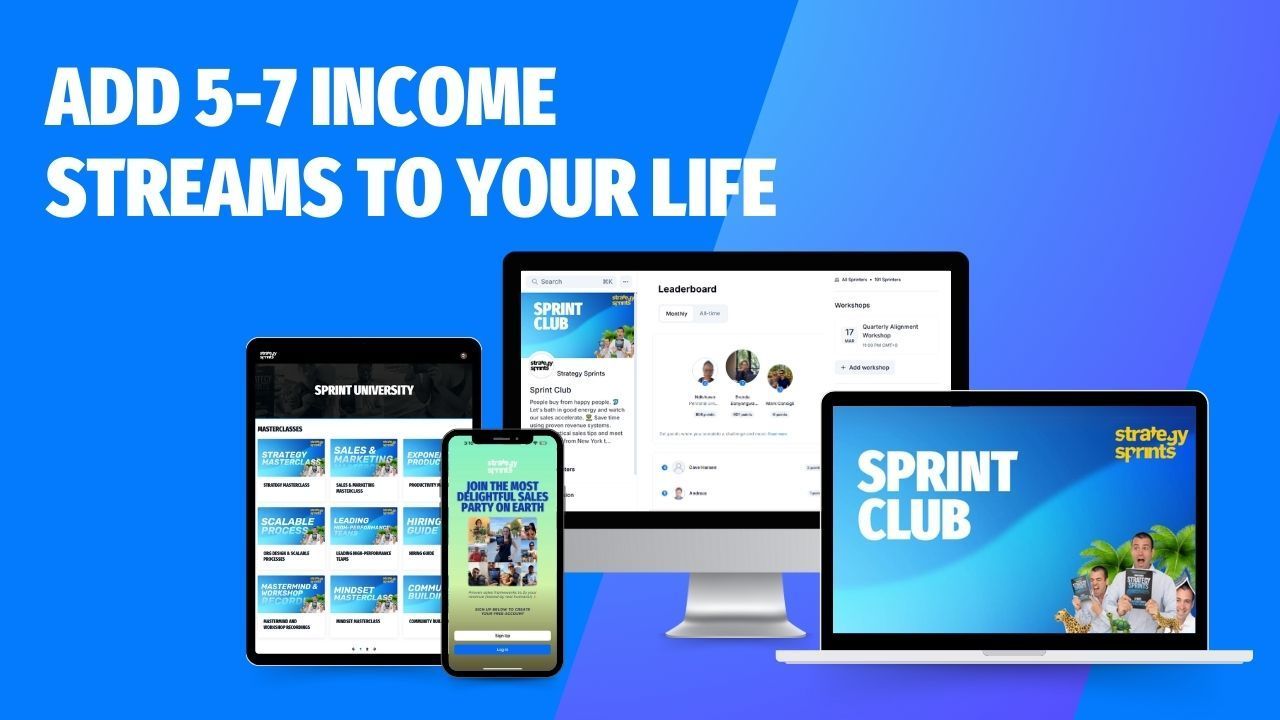
If you want the tools, the AI skills and a crew that practices this every week, join the Sprint Club, 7 days free: https://www.strategysprints.com
Ready to accelerate now? Book a Discovery Call: https://calendly.com/strategysprint/discovery-call
Happy hunting.
Simon & The Sprinters 🐬⚡️🐆
Lead your next deal, first call to signature. 🌴
The 36 Sales Gaps Checklist: 36 places a deal dies, and the fix for each. Free, one page.
Free. You get the checklist, then more sales tools like it by email from Strategy Sprints. Leave in one click, any time.