Close Bigger Deals Under Pressure: Find Your Pain Zone and Keep Rolling
You just said the price.
Now there's silence. Three seconds that feel like thirty. Your chest tightens, your voice wants to fill the gap, and a little voice in your head starts talking fast: "Too much. Say something. Offer the smaller package before they walk."
That voice is the most expensive voice in sales. 🐯 Take 10% off a $30,000 deal to escape the silence, and you just paid $3,000 for three seconds of discomfort.
Rowers know it well. Somewhere in the middle of a 2,000 meter race, the legs fill with lactate and the lungs start to burn. An untrained brain reads that burn as an emergency and eases off. A trained rower reads the exact same signal as information: this burn means the split is where it needs to be.
Same body, same burn, two completely different stories. One story slows the boat. The other one wins the race.
Sales works the same way.
The burn is not the emergency
For a long time, sport science thought athletes stopped because their muscles failed. The newer view, which Matt Fitzgerald lays out in How Bad Do You Want It?, is the psychobiological model of endurance: fatigue is regulated mostly by the brain's perception of effort, long before the muscles actually give out.
Alex Hutchinson goes deeper in Endure. The brain acts like a protective governor. It pulls you back early, to keep a safety margin. And the research he covers shows that the way athletes talk to themselves changes how hard the effort feels.
Here's the sales translation 🐬
Often the buyer could afford the deal just fine. It shrinks because the seller's brain reads the tension in the room as danger, and lets off the pressure. The discount comes out. The proposal goes out too early. The hard question never gets asked.
Nothing was wrong with the deal. The governor just pulled the oars in.
Where your pain zone sits
Every sales call has its own "third 500 meters", the stretch where it starts to hurt. In the 8 Steps of the Repeatable Sale, it shows up in four places:
- Step 2, Frustration. You ask what they've already tried, and you hear things that are uncomfortable to hear.
- Step 4, Cost of Inaction. You ask "What happens if you do nothing?" and then you have to stay quiet while they think.
- Step 6, Investment. You say the number. Once. Out loud.
- Step 7, Starting Date. You ask for a specific date, not "soon".
And outside the call, prospecting has its own burn: the tenth no of the morning, the message nobody answers.
These moments are your pain zone. They're also your max performance zone. The places where it hurts are the places where the deal actually moves. 🌴
From alarm to process
The goal is not to deny the discomfort. And it's not to shout yourself through it with hype. "No pain, no gain" doesn't help a rower at 1,200 meters, and "always be closing" doesn't help you at minute 25 of a discovery call.
The goal is to switch the story in your head, from an alarmist narrative ("this is going badly, back off") to an objective, process-focused one ("this tension means I'm in the part of the call that matters, next step").
Sport psychologists sort self-talk into a few working types: instructional cues (what to do), motivational framing (why it's worth it), and reframing the negative thought that just showed up (Latinjak and Hatzigeorgiadis cover this in Self-Talk in Sport). Here's how that looks in a sales call:
- Naming the feeling: instead of "My heart's racing. They hate the price." say "Pulse is up. That means I'm at the real part of the call. Let it work."
- The next action: instead of "Just get through this call." say "Ask Step 4. Stop talking. Count to five."
- Accepting it: instead of "Why did I quote this high? I want out." say "I asked for this moment. Sit in it. Breathe out."
Notice what the second version does each time. It doesn't pretend you feel great. It names the feeling, gives you one thing to do, and keeps you in your seat.
Real toughness is calm, not loud
Steve Magness, in Do Hard Things, takes apart the old macho idea of toughness. Real toughness, in his view, is the space between stimulus and response: you feel the discomfort, you treat it as data, and you choose what to do next instead of reacting.
That's what control in sales looks like. 🐯
The needy seller reacts. Silence comes, and they rush to fill it. A buyer frowns, and they cut the price. They're not weak people.. they just let the alarm drive.
The seller in control feels the exact same alarm, and doesn't obey it. They let the silence do its job, because the buyer is busy working out what doing nothing will cost them. That number, said in the buyer's own words, is what makes your price look small later.
The Brave Athlete by Simon Marshall and Lesley Paterson gives this a useful picture: the "chimp" part of the brain that panics under strain. You don't win an argument with the chimp. You give it a simple mechanical command. Rowers use cues like "breathe out, loose hands, hang on the handle." In sales, try:
- "Breathe out. Slow voice. Next question."
- "Their number first. Mine second."
- "Say it once. Stop."
Brace and accept: expect the burn before it comes
A rower who expects the burn at 1,200 meters doesn't panic when it arrives. Fitzgerald calls this brace and accept: you tell yourself early that it's going to hurt, so the brain doesn't treat the hurt as a surprise.
You can do the same before every call. 🐬 Take one minute and write down where it will get tight:
"Minute 20: I ask what doing nothing costs them. Silence. Good. Minute 30: I say the number. It will feel heavy. That's the split. Minute 35: I ask for a starting date. A real one."
Now the tension has a place on the map. When it shows up, it's not a threat. It's a checkpoint you planned for.
Your race plan on one card
Here's a simple card you can keep next to your screen during calls:
- Before: "The tight moment comes at Step 6. Good."
- Step 4: "Ask. Silence. Their cost, not my pitch."
- Step 6: "Say the number once. Stop talking."
- Step 7: "A date, not soon."
Then score it. In our Friday Learnings, one question does a lot of work: where did I let up this week? Which call, which step, which sentence. Not to beat yourself up, but to find the exact meter where your governor pulls back. That's where next week's practice goes. 🌴
Know the burn from the injury
One honest line here. Rowers know the difference between the burn of race pace and the sharp pain of an injury. One you push through, the other you stop for.
The sales version: the tension of asking a hard question is the good burn. Working fourteen hours, missing dinner, losing sleep over a deal that should have closed weeks ago.. that's not the pain zone. That's the grind.
The pain zone is short and intense. A few minutes per call, a focused hour of prospecting. Full intensity, fully present, then you recover. That's what we call a Sprintlife: control in sales plus time freedom, so the effort turns into money, thank-yous, and purpose instead of exhaustion. 🐯
Keep rolling (and don't row alone)
Nobody learns to sit in the burn alone. Rowers have a coxswain calling the stroke, a coach on the bike, a crew pulling with them.
Sales is no different. In our Sales Gym we practice the 8 Steps over and over with spotters, people who push you through your current sales wall, until the silence after "what happens if you do nothing?" feels like home. Over 2,400 B2B founders have gone through our programs, and this is what we practice with them. 🐬
Picture your next call. You say the number. You stay quiet, hands flat on the desk. And the buyer asks: "Okay. When can we start?"
The burn will always be there. That's the toll of moving a deal at race pace. The only question is which story you tell yourself when it arrives.
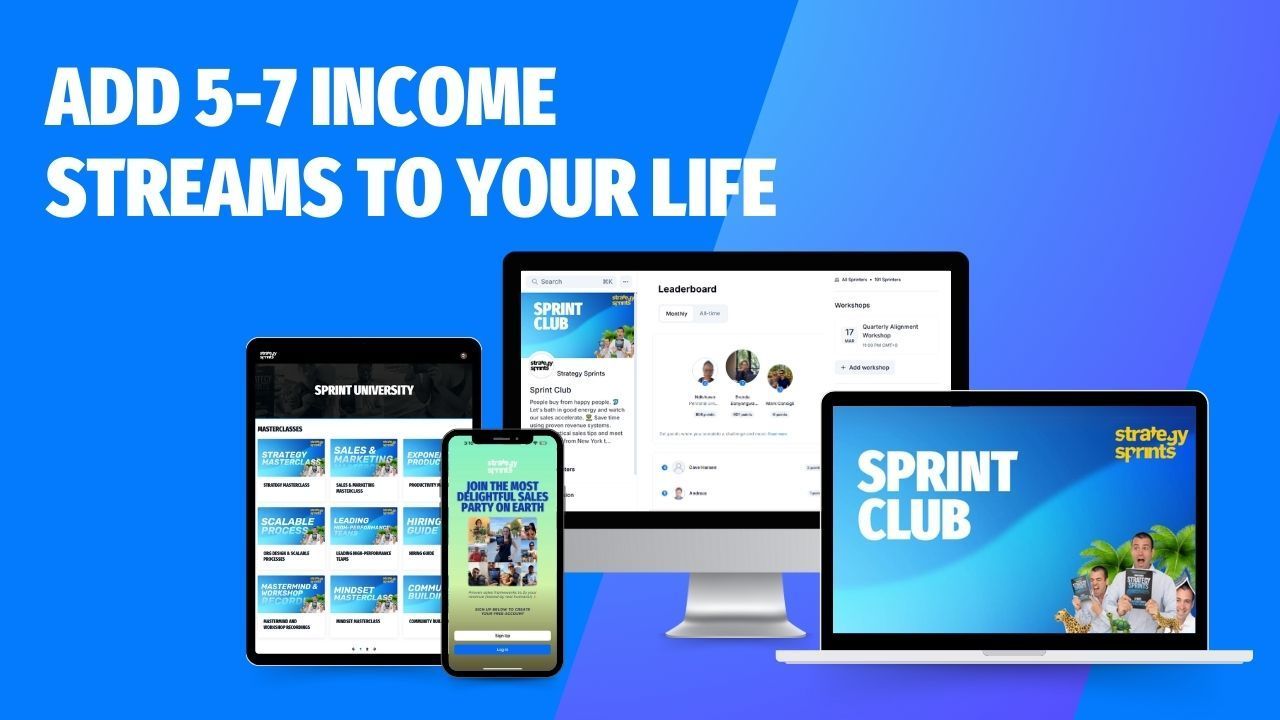
Want the tools, the AI skills, and a crew of founders who practice this every week? Join the Sprint Club, 7 days free: www.strategysprints.com
Ready to accelerate now? Book a Discovery Call: calendly.com/strategysprint/discovery-call
Happy hunting.
Simon & The Sprinters 🐬⚡️🐆
Lead your next deal, first call to signature. 🌴
The 36 Sales Gaps Checklist: 36 places a deal dies, and the fix for each. Free, one page.
Free. You get the checklist, then more sales tools like it by email from Strategy Sprints. Leave in one click, any time.