How to Win More Sales Deals: The 8-Step Control Framework
How do you win more sales deals?
Keep control of the conversation. Most deals are lost the moment a buyer asks "Can you send me a proposal?" and the seller answers yes instead of asking a question. The 8 Steps of the Repeatable Sale keep you leading: Visualize, Frustration, Importance and Cost of Inaction on the first call, then Deliverables, Investment, Starting Date and Statement of Work on the second.
Updated October 2026
You're not losing deals on price, competition, or the economy. You're losing them the moment you hand the buyer control. Here's the 8-step framework that gets it back.
The reason you're losing deals has nothing to do with your price. It has nothing to do with your competition. It has nothing to do with the economy.
You're losing because the buyer is in control, and you let them get there.
Most salespeople walk into a meeting needy. They show up hoping. They come out of that meeting waiting. Hoping and waiting are not sales strategies. They are surrender.
Here's the pattern. You get on a call with a prospect. You've done your homework, you're prepared, the first five minutes go well, there's real rapport. Then they ask, "Can you send me a proposal?" And something shifts. A tiny panic hits your stomach: I need to close this, I'm losing him. So you say yes immediately. You explain your services, justify your pricing, send the proposal same-day, maybe with a discount already baked in just to smooth it over.
Then you wait. And wait. A follow-up: "just checking in." Silence. Another follow-up: "wanted to make sure this didn't fall through the cracks." Silence. That's the beginning of a ghosting relationship.
Here's what actually happened: you handed over control the moment you answered their question instead of asking your own. The buyer asked, the seller answered. The buyer led, the seller followed. That isn't selling. That's responding.
The fundamental problem was never your pitch or your deck. It's that you were operating in the buyer's frame, not yours. Staying in someone else's frame feels polite, feels professional, feels "customer-focused." But the buyer doesn't actually want a yes-person. A real act of service is leading the conversation, because you're the expert who knows what's coming for them, ten steps before they do.
Control is a skill, not a personality
Here's the part most people get wrong: control isn't a personality trait. It's a skill, and like every skill, it can be learned, practiced, and installed.
A clear process changes what the buyer feels on the other side of the table too. When they sense you have a plan, that step two comes before step three, they trust you more before you've said a single persuasive word. The amateur move is jumping straight to price before you understand the problem, the timeline, or what happens if they do nothing. Do that, and the buyer stops feeling safe, and they walk.
The spotter analogy
Think about walking into a gym to attempt a new personal record, at a weight you've never lifted. Most people fail alone, not because they're weak, but because they're in their own head. They second-guess the movement at the exact wrong moment and bail.
Now imagine a spotter who's seen this lift a hundred times, who knows exactly where the failure point will be, who tells you to breathe and adjust your grip before you're even under the bar. The spotter isn't controlling you. They're giving you the structure to hit a rep you couldn't hit alone.
That's exactly what a repeatable sales process is. Not a script. A spotter.
The 8 Steps of the Repeatable Sale
Here's the actual framework, walked through call by call.
First call:
Step 1, Visualize. Visualize what the other person is saying, not just cognitively but on a body level. Mirror, pace, then lead.
Step 2, Frustration. What's pissing them off? What have they already tried? Did they give up, or are they still trying?
Step 3, Importance. In the context of everything else going on, how important is this?
Step 4, Cost of Inaction. What happens if they do nothing? What else could they do instead? Which other options, and which criteria, are they weighing?
By the end of that first call, you schedule the second one.
Second call:
Step 5, Deliverables. Come back to the three deliverables, in the buyer's own wants and needs, in their own words.
Step 6, Investment. Time and money. Not price, not cost. Investment.
Step 7, Starting Date. When do we start?
Step 8, Statement of Work. Signed in that same session. That's the close.
This is muscle memory work, not a one-time trick. It takes practice, repeated inside 72 hours, or the body forgets it and you start over as a beginner.
What changes when you stop selling without a spotter
If you've been losing deals, it isn't because you're not persuasive enough or not likeable enough. It's because you've been walking into every sales conversation without a spotter.
That's fixable, starting with your very next call. Every one of the 8 Steps above is something you can install this week, not something that requires a personality transplant.
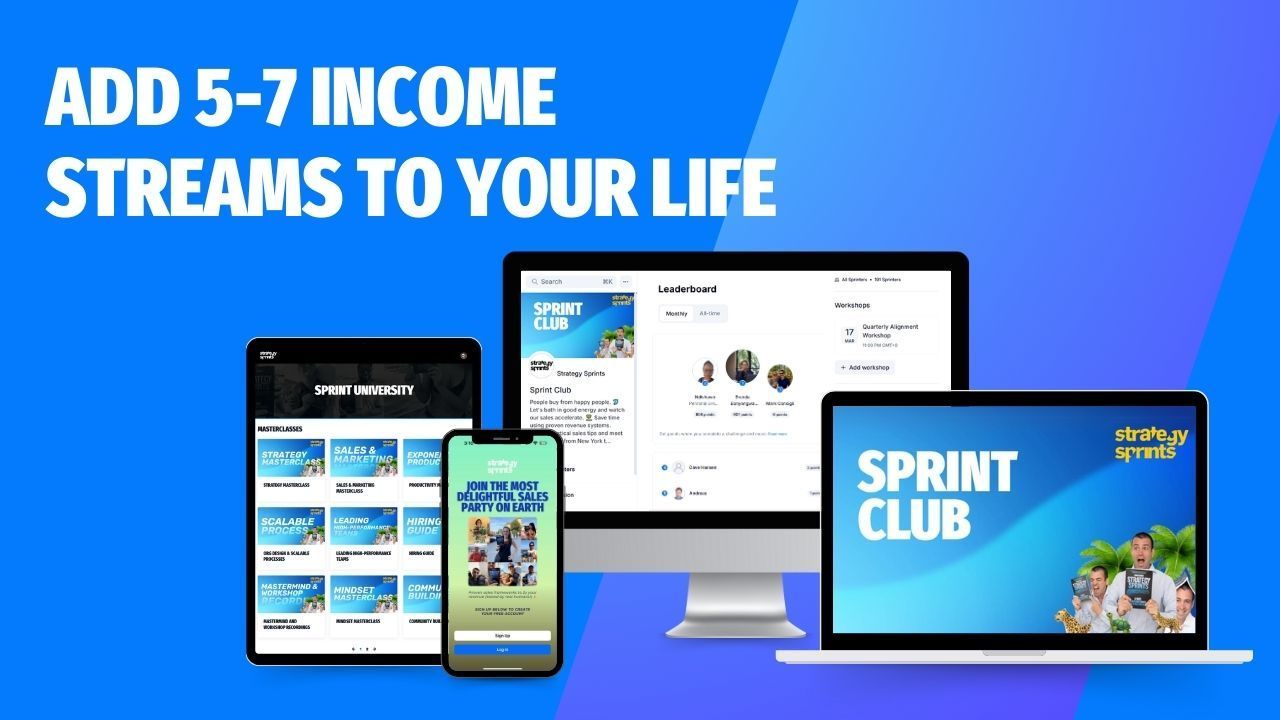
We call the place where you install it the Sales Gym. Get the key and train on your own, join a live class, or bring your whole team in for private training. However you need it, you can try it free for 7 days at www.strategysprints.com.
Go sell something.
Simon & The Sprinters 🐬🐯🌴
Get your free strategy tools: www.strategysprints.com/tools
P.S. Three ways to work with us when you're ready:
- Join Sprint Club for the full 8-step process, live coaching, and 47 AI skills, starting free for 7 days: www.strategysprints.com
- Land your next 3 large clients with the 90-Day Sales Acceleration Sprint: book a call at www.strategysprints.com
- Get a 1:1 Sprint Coach for you or your team: book a free Discovery Call at calendly.com/strategysprint/discovery-call
Lead your next deal, first call to signature. 🌴
The 36 Sales Gaps Checklist: 36 places a deal dies, and the fix for each. Free, one page.
Free. You get the checklist, then more sales tools like it by email from Strategy Sprints. Leave in one click, any time.