The Decision You Keep Avoiding
Here is a scene you have lived.
You built the company. You made every call for five years. You can feel it in your hands, that particular grip on every deal, every hire, every fire. Now the company cannot make a single move without you.. and when you are on a flight or in a hospital or on vacation, every decision quietly stacks up waiting.
That is not loyalty. That is a bottleneck. Not a character flaw.. a decision you have not made yet.
I sat down with Cameron Herold recently. He scaled 1-800-GOT-JUNK from 2 million to 106 million, then spent the next 19 years building COO Alliance around the exact problem we talked about.. the founder who cannot let go.
I asked him the direct question. What is the number one thing founders do to stay the bottleneck in their own business.
His answer was not what I expected. Not hiring. Not time management. Focus.
"If you take light and disperse it, it lights up a room," he told me. "But if you take that same light and highly focus it, it becomes a laser beam."
The founder who checks social media in one tab, the news in another, three mastermind groups pulling three directions, and a stack of books everyone insists they read this month.. that is dispersed light. None of it is wrong. All of it is diffuse. Diffuse light does not cut through anything.
Here is the reframe that stuck with me. You do not have a hiring problem. You have a decision you are avoiding: who runs this without you.
The answer to that question is usually a task. Hire an assistant. Buy software. Block a Friday for "strategic thinking." None of that touches the real decision.
Cameron's line on this was blunt: "If somebody says, I can't delegate this because I don't have anyone to do it.. it's because you actually suck at delegation."
Not an insult. A diagnosis. Nobody trained us to interview, to onboard, to run a one-on-one, to hand off a project and actually get back what we needed. So we default to doing it ourselves, and we call that being hands-on.
He gave me the fix in four rules. Concrete enough to use in your next handoff today.
One. Tell the person exactly what you need back when the project is done. Not "handle this." The actual result, specific enough that they know when they are finished.
Two. Tell them how little time you want them to spend. Cameron's example: "Clean the office, don't spend more than 30 minutes" gets it done in 29. The open-ended version gets 8 hours chasing perfect. He put a number on the difference: seven and a half hours saved.
Three. Tell them how little money to spend. Time and money both need a ceiling or the project expands to fill whatever room you leave.
Four. Confirm they have the skill and the confidence to do the work. If they do not, that is a coaching task, not a delegation task. Now you know.
"They miss those four massive things," Cameron said. "And then they sit down and go, my team's terrible, I have to do the work myself. Well, no. You just don't understand delegation."
We talked next about when to make the bigger hires. His sequencing is simpler than it looks.
First: an executive assistant, the moment you notice you are doing work below your effective hourly rate.. booking flights, managing your inbox, scheduling.
Second: a second in command. Maybe a general manager. Maybe a director of operations. Maybe eventually a COO, once you stop having time to grow the people who report to you.
He drew the line between those roles cleanly. A director is someone you tell what to do. A VP is someone you decide direction with, together. A true COO walks in already owning the P&L, understanding cash flow, bringing strategic insight without supervision. Know which one you are actually hiring before you write the job description.
Then I asked him the harder question. What decision do founders avoid the longest, even when they already know the answer.
Firing.
"If you went to a doctor today and found out you had a cancerous tumor in your lung, you wouldn't leave it there for six months," Cameron said. "So many entrepreneurs find out that Bob isn't doing a great job, or Bob is driving everybody crazy, or Bob doesn't live the core values. But they keep him for six more months, or three more months, or one more month. Bob is a cultural cancer."
Sometimes founders delay because they have never done it before. More often, it is because they still need to be liked. That need for approval is exactly what keeps a cultural cancer alive past the point everyone else in the company already sees it.
Cameron is equally direct about AI. AI can produce a beautifully formatted four-page report from a meeting when the only thing anyone needed was three bullet points. "AI can often expand, not because it's doing anything wrong, but because it's so good at producing content, it can actually make people busier versus more productive."
AI cannot replace the one thing every leader still has to do: decide the next action. That is not a data problem. That is judgment.
Then he turned the conversation somewhere I did not expect. Delegation is not only a business skill. It applies to your whole life.
He described his own Vivid Vision.. a full written paragraph describing exactly what his life looks like three years from now. Not just revenue targets. What he does for fun. What he does for fitness. What he and his wife are building together. What he is doing for spiritual growth. He reads it, checks it against his actual weeks, and adjusts.
"You can't have perfect balance every day and every week of the year. I almost see you and I like elephants standing on a teeter-totter." Some weeks tilt fully toward work. Some weeks tilt fully toward the people he loves. The system is not balance. It is trust that you will come back and correct course.
Here is the proof that delegation is not surrender.
Andrea, seven-person team, Munich. Win rate: 18% in, 34% out. Sales cycle: 67 days down to 41 days. The lever was not a new script. It was a hard Starting Date on someone else's calendar, not hers. Andrea handed off Step 6 through Step 8 of the 8 Steps.. Investment, Starting Date, Statement of Work.. and stopped being the only person who could close a deal.
She did not lose control. She recovered it.
Here is your test this week. Open your calendar. Count the deals, the hires, and the fires that only get resolved because you personally show up. That count is your bottleneck score.
More than three? You already know the answer.
You do not have a team problem. You have a decision you have been avoiding. And decisions close. Avoidance compounds.
Watch how Cameron fixed it: https://www.youtube.com/watch?v=Q3UwiTbawJE
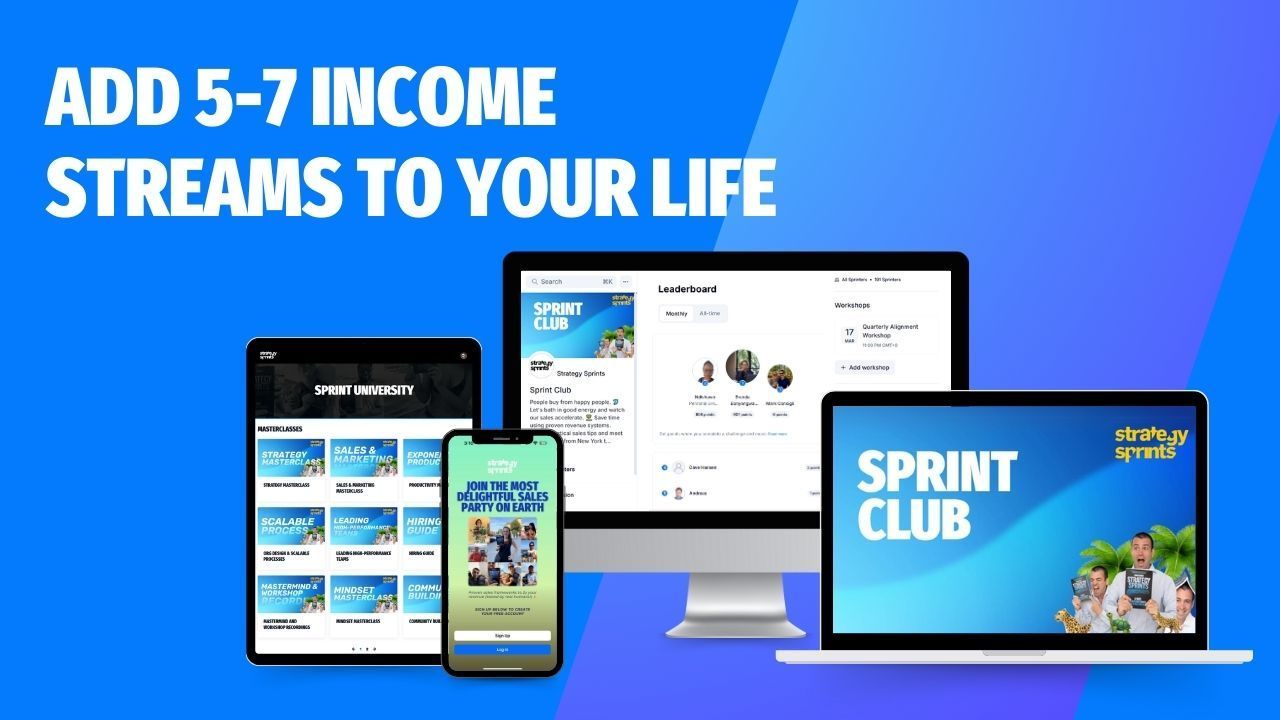
Founders are practicing this live inside Sprint Club.. weekly coaching, real numbers, real handoffs. Seven-day free trial:
https://www.strategysprints.com
Happy hunting.
Simon & The Sprinters 🐬⚡️🐆
Lead your next deal, first call to signature. 🌴
The 36 Sales Gaps Checklist: 36 places a deal dies, and the fix for each. Free, one page.
Free. You get the checklist, then more sales tools like it by email from Strategy Sprints. Leave in one click, any time.