Growth Strategy and Sprints: The 8-Step Weekly Revenue Loop
How do you turn a growth strategy into weekly revenue?
Run it as a weekly loop that gets sharper every week, not a yearly plan that goes stale in a folder. On Monday, set one priority and one guiding policy (Monday Strategy). On Friday, score what worked, what to double down on and what to drop (Friday Learnings), then adjust next Monday. Inside that loop, every sales conversation follows the 8 Steps of the Repeatable Sale in order: Visualize, Frustration, Importance, Cost of Inaction, Deliverables, Investment, Starting Date, Statement of Work.
Updated October 2026
Growth strategy is not a plan. It is a loop you run every week.
Search "growth strategy" and you get frameworks. Slide decks. Quadrants. None of them tell you what to do on Monday morning, and none of them tell you what to do on Friday afternoon when the week is over and you need to know if any of it worked.
That gap is why most growth strategy work never turns into growth. You write the plan once, in a workshop or an offsite, and then you go back to running the business the old way. The plan sits in a folder. Nobody reopens it until the next annual review, by which point the market has already moved.
A real growth strategy is not a document. It is a sprint: a short, repeatable cycle of decide, act, measure, adjust, that compounds week over week instead of resetting every quarter.
Why "strategy" and "sprints" have to be the same word
Strategy without a cadence is just an opinion you had once. Sprints without a strategy are just busywork with a deadline attached. Put them together and you get something different: a weekly operating rhythm where the direction gets set, tested against reality, and corrected on a fixed schedule, instead of drifting for months before anyone notices it is off course.
This is the core method behind every 90-day acceleration we run: Monday Strategy, Friday Learnings.
Monday Strategy sets the week's direction. One priority, one guiding policy, decided in minutes, not days. You are answering one question: given everything you now know, what is the single highest-leverage move for the next five days?
Friday Learnings scores the result. What worked. What to double down on. What to drop. This is a backward-looking scorecard, filled out the same time every week, tracking the buyer journey from first attention through referral.
The loop closes itself: Monday sets the intention, Friday scores the result, next Monday adjusts based on what was actually learned, not what was hoped for. That is a growth strategy that gets sharper every single week instead of stale every single quarter.
The 8 Steps of the Repeatable Sale: the engine inside the sprint
A growth strategy that does not touch how you actually sell is theater. Revenue is the scoreboard, and revenue comes from conversations. Inside every sprint, the same eight steps govern every sales conversation, in this order, every time:
Step 1: Visualize. Picture what the other person is describing (visualizing), repeat their last two or three words back to them (mirroring), match their energy and pace (pacing), then guide the direction once trust is established (leading). You do not move forward until this is real.
Step 2: Frustration. What has the buyer already tried? What is not working? This is where the real pain surfaces, and skipping it is the single most common reason deals stall later.
Step 3: Importance. How does this problem rank against everything else competing for the buyer's attention this quarter? A problem that matters in isolation but not in context never gets funded.
Step 4: Cost of inaction. What happens if nothing changes? Let the buyer say the consequence out loud instead of saying it for them. Silence does more work here than any pitch.
Step 5: Deliverables. What does the buyer want to achieve in the next ten days? Their own words become the basis of the statement of work.
Step 6: Investment. Time, people, money, in that order. Price comes last, never first.
Step 7: Starting date. A specific date. Not "soon." Not "next week." A commitment is the close.
Step 8: Statement of work. Sent before the next meeting, ready to sign, not a draft.
Run these eight steps inside a Monday-to-Friday sprint and you get a growth strategy with a pulse: every conversation feeds the scorecard, every scorecard sharpens the next week's priority. Each step is broken down in full on the 8 Steps of the Repeatable Sale page.
What a 90-day growth strategy sprint actually looks like
Most acceleration work breaks down for one of two reasons: the strategy is disconnected from the day-to-day sales motion, or the sales motion has no strategic filter deciding which deals are worth chasing. A sprint-based approach fixes both at once, and the pattern holds across industries: B2B software, consulting, and financial services all run the identical eight-step loop, because the buyer psychology underneath a purchase decision does not change by vertical.
One Private client, a company doing roughly $3M a year, ran this exact loop for 90 days and grew revenue 130%, a 144x return on the engagement. That result did not come from a new tactic. It came from running the same weekly cycle, decide, act, measure, adjust, without skipping a Friday.
The credibility behind this method predates Strategy Sprints itself. Before building this firm, the same operator personally coached more than 2,000 sales and negotiation teams, including at Google, BMW, and Airbus. Since then, more than 2,400 B2B founders have run this exact system inside Strategy Sprints. The names change. The loop does not.
Where growth strategy actually breaks
The honest answer is almost never "we don't have a strategy." It is "we have three strategies competing in the same week and no scorecard telling us which one is winning." Pick the wrong bottleneck to target, and the sprint accelerates the wrong thing, faster. That is why targeting the actual business bottleneck comes before any tactic gets chosen, and why the strategy map exists as a five-step filter, not a five-year plan.
Once the bottleneck is correctly identified, the sprint itself follows a fixed shape. If you have not run one yet, the six stages of a sprint walk through exactly how a week gets structured from Monday's decision to Friday's scorecard.
How to start this week
You do not need a strategy offsite to start. You need one Monday and one Friday.
This Monday: pick the single highest-leverage priority for your sales pipeline, and write down the guiding policy behind it in one sentence.
This Friday, same time: score the week against the buyer journey, from first attention through referral. Name one thing that worked, one thing to drop, and next Monday's priority.
Do that four times and you have a 30-day cycle. Do it twelve times and you have the same 90-day arc referenced above. The mechanism is not complicated. It is just repeatable, and most companies stop repeating it after the second week.
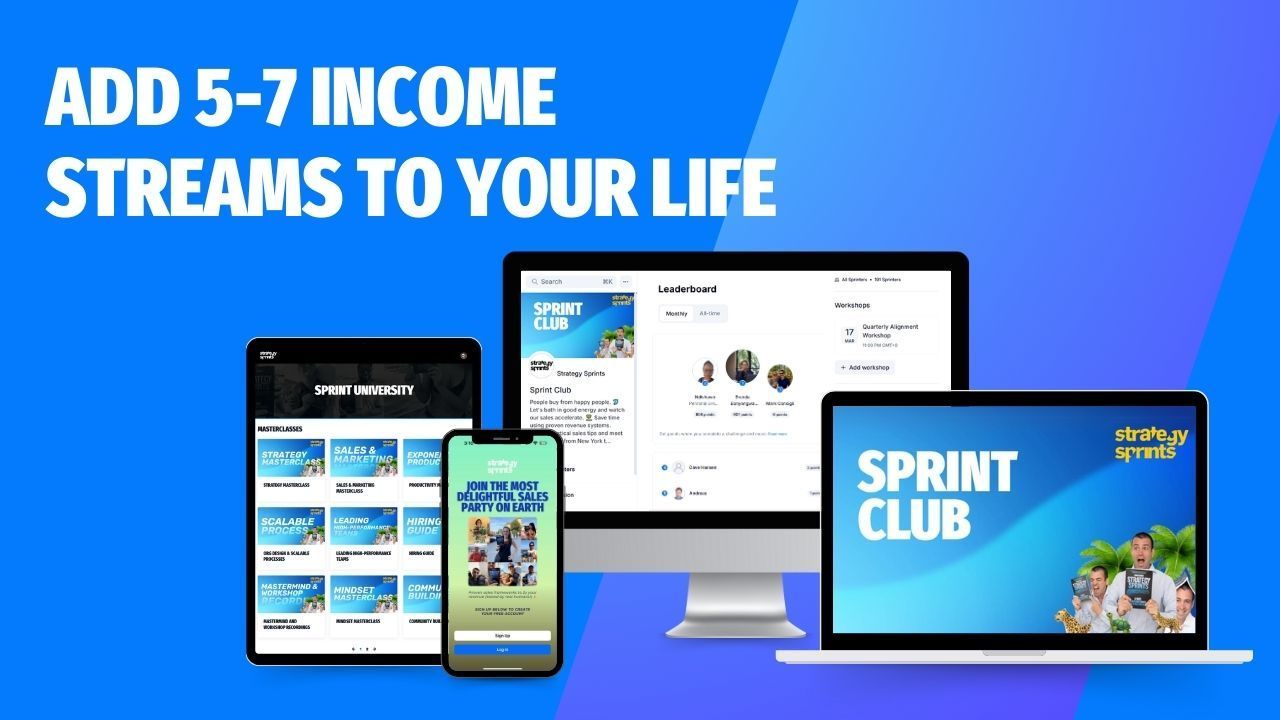
If you want the full system, not just the outline, the 200K Club runs this exact Monday Strategy and Friday Learnings loop with a small group of founders every week, and Sprint Club gives you the tools and templates to run it solo starting today, free for the first seven days.
Start today:
- Try Sprint Club free for 7 days, then $49/month, for the templates, AI skills, and community running this loop right now: start your free trial
- See the full 8-step system: the free tools library
- Book a Discovery Call to build your first sprint together: book your call here
Simon & The Sprinters
Lead your next deal, first call to signature. 🌴
The 36 Sales Gaps Checklist: 36 places a deal dies, and the fix for each. Free, one page.
Free. You get the checklist, then more sales tools like it by email from Strategy Sprints. Leave in one click, any time.