Stop Discounting in B2B: How to Answer "Why Not Your Competitor?"
The pitch went well. The buyer nodded. Then came the question that kills the deal, or kills the price:
"Why shouldn't I use your competitor?" 🐯
If that question makes you reach for a discount, this chapter of my book is for you.
A start-up that kept losing to the market leader
Chapter 1 of Strategy Sprints opens with a tech start-up. Their sales reps made pitch after pitch to large enterprises, with "excellent pitch decks on the benefits and features". And at the end of every pitch the buyer asked the same thing: "'Why shouldn't I use your competitor?'"
The reps "would mumble a weak answer". The competitor was the market leader. The result, in the book's words: "One sales rep after the other was fired."
Here's what I wrote about it:
"As the start-up was finding its footing, they were trying to figure out who they were like, instead of where they were different."
That's what I call the vanilla problem. You define yourself next to the competition, so the buyer compares you. And the book is blunt about what comparison does: "you will always be compared, and that will drive prices down, which eats up your profit margins."
The day a buyer jumped up and down
Then a new rep got a meeting with the head of logistics at a big global shipping company. The buyer asked for a feature. The rep showed it. In the book: the client "physically jumped up and down, then ran to call his colleagues into the meeting."
The next shipping company asked the same question. A pattern.
So they made a choice that felt risky. They stopped selling enterprise software and went all-in on being software for global shipping. And then the phones turned around. Instead of reaching out, "those groups were picking up the phone to call the tech start-up."
Their new answer to the killer question fit in one breath: the competitor is the best generalist for its own perfect customers, but you are a global shipping company, and we are the software for global shipping.
The business grew "from just a few million dollars to nearly 20 million" and later "sold for around a billion dollars."
The line I took from it:
"You don't need hundreds of clients. You need one client, hundreds of times." 🐬
Prince Charles or Ozzy Osbourne?
Going narrow only works if you know who "one client" is. And here's where demographics fool you.
The book gives a quick test. Guess who this is:
- Age 65+
- Father
- Married twice
- Born in England
- Dog lover
- High net worth individual
Prince Charles (the book came out before he became King)? Correct. Ozzy Osbourne? Also correct.
Same profile. Two very different people. The offer that lights up one would bore the other. As the book says: "Demographics are just the surface. You have to go deeper."
The 9 layers that go deeper
Chapter 1 gives nine questions. Answer them about one real client you'd love to clone:
- Who is your ideal client?
- What are their dreams?
- Their aspirations?
- What keeps them awake at night?
- What are their beliefs?
- What do they hate most?
- Which problems do they need to solve?
- Who do they want to impress?
- Who is around them, expecting something from them?
Questions 4 and 7 are where your sales call lives. Questions 8 and 9 are where your price lives. When you know who your buyer wants to impress and who's waiting on them at home, you stop selling features. You sell what they get to be 🌴
The Equalizer: decide where you're #1
The last tool in the chapter turns this into a decision. The book calls it the Equalizer Spreadsheet.
- List the benefits clients buy in your market (speed, expertise, CEO-to-CEO access, whatever is true in yours).
- Grade yourself and each competitor from 1 to 10 on each one. Winning is 7 to 10. "Meh" is 4 to 6. Losing is 1 to 3.
- Sort every benefit into three buckets: Eliminate, Reduce, Double-Down.
What you double down on "becomes your definition". That's your answer the next time a buyer asks about your competitor. Calm, specific, and yours.
Run this with your team this week
Block 90 minutes. Founder, sales and marketing. One whiteboard, a fresh pack of markers.
- Say the killer question out loud. Each person writes down the answer they give today when a buyer asks "why not your competitor?" Read them aloud. Do they match? Do they sound like you, or like everyone?
- Run the Equalizer. List 6 to 8 benefits. Grade yourselves and your two biggest competitors. Be honest about the "meh" 4s, 5s and 6s.
- Pick one client to clone. Answer the 9 questions about that person. Real name on the board, not a persona.
- Write the one-sentence answer. "They are great for [their buyers]. You are [the buyer's world]. We are the [what you do] for [that world]." Test it on each other until it lands.
- Use it on every call next week. On Friday, note what happened when the question came up.
The bitter part is choosing what to let go. The sweet part is that buyers stop comparing you 🐯
Where this comes from
This is Chapter 1, "Eliminate the Competition", of my book Strategy Sprints: 12 Ways to Accelerate Growth for an Agile Business (Kogan Page). The chapter also covers how to write a vision you can feel, and why it beats a mission statement. Teams read it together, one chapter a week.
Get the book: https://www.amazon.com/s?k=Strategy+Sprints+Simon+Severino&i=stripbooks
Do it together
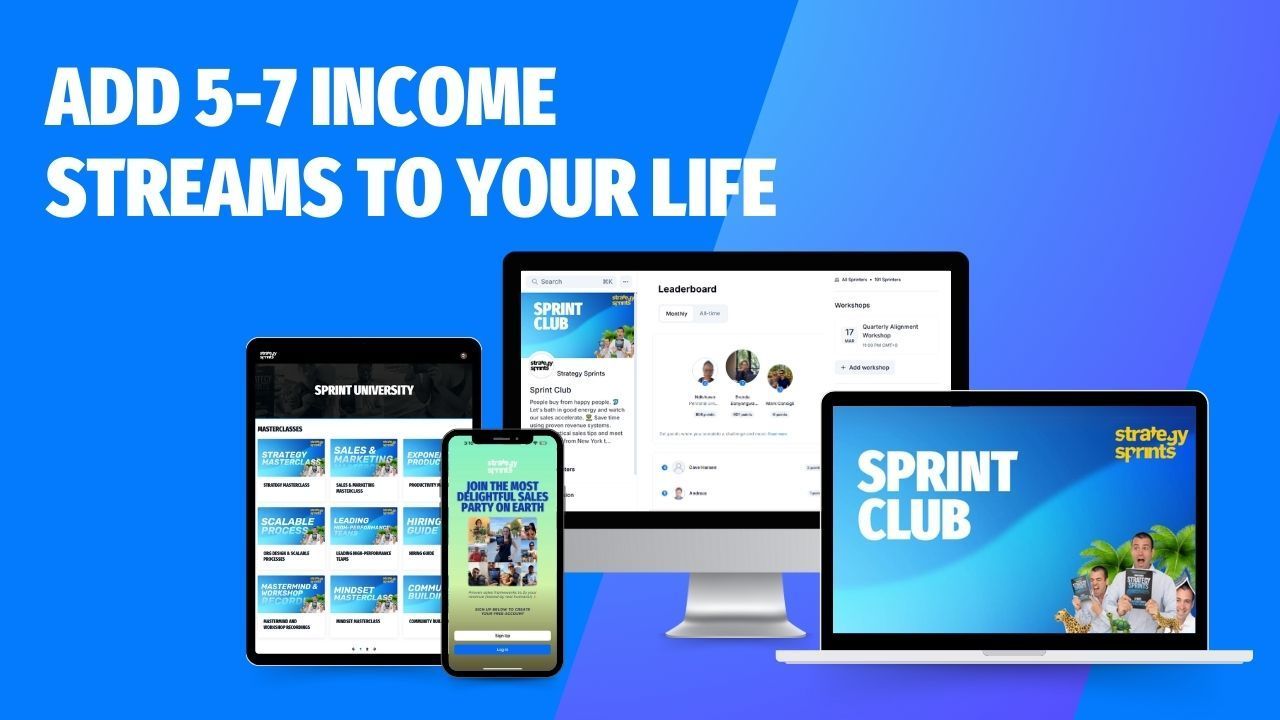
Positioning is hard to see from inside your own company. Easier with founders who'll tell you the truth. Sprint Club is where founders do this work together, with the tools and AI skills we use ourselves. 7 days free: https://www.strategysprints.com
Ready to accelerate now? Book a Discovery Call: https://calendly.com/strategysprint/discovery-call
Happy hunting.
Simon & The Sprinters 🐬⚡️🐆
Lead your next deal, first call to signature. 🌴
The 36 Sales Gaps Checklist: 36 places a deal dies, and the fix for each. Free, one page.
Free. You get the checklist, then more sales tools like it by email from Strategy Sprints. Leave in one click, any time.