How to Close Bigger B2B Deals: Stop Discounting in the Silence After the Price
You say the price.
Then silence.
Three seconds. It feels like thirty.
And a voice in your head says: "Too much. Offer the smaller package."
That voice costs you more money than any competitor ever will. 🐬
I race as a competitive rower now, and the same voice shows up in the boat, at almost the same moment: right when it starts to hurt. Here's what rowers do with that voice, and how you can do the same on your next call, so you close bigger B2B deals instead of shrinking them in the quiet.
You can watch the full episode here: https://www.youtube.com/watch?v=0HgEidNUero
The moment the deal shrinks
Picture it.
You named the number. The buyer looks down. Says nothing.
Your chest gets tight. Your mouth goes dry. You can hear the clock on the wall. The room suddenly feels airless.
Your brain reads all of it as danger. So you rescue the moment.
"We could also start smaller."
"There's some flexibility there."
Nobody asked for that. The buyer was just thinking. 🐯
Now do the math. Take 10% off a $30,000 deal. You just paid $3,000 for three seconds of silence. And that discount leaves a bitter taste for the whole project.
Often the buyer could pay. The deal shrinks because the seller can't sit in the tension.
Every week I get five to seven recordings of sales calls, and this is the moment I watch for. It's the same moment, call after call. The tension doesn't go away with experience. It won't go away with a better script either.
So the real question is not how to make the tension disappear. The question is what you tell yourself when it shows up.
What rowers know: the burn is a signal, not a stop
A 2,000 meter rowing race is short and brutal. After about a thousand meters, my brain starts talking.
"My heart is going to explode. I have to stop."
"My legs burn. I have to stop."
"I can't breathe."
Those are the sentences I hear in my head.
My coach says: when you hear this, don't just follow that voice. Note down when it came. Was it at meter 1170 or 1190? Write it down. That's part of the training: you start to observe when your mind gives you signals. 🌴
Because the mind signal is not the reality. The reality of your body is that you can probably do 40% more than your mind tells you. Every competitive athlete knows this and trains it. You only win gold medals if you stop following those voices and have better sentences ready. 🐯
Here's the difference between a trained rower and an untrained one.
Around the middle of the race, the legs fill with lactate and the lungs burn. The untrained rower thinks: "My legs are dying. I have to ease off."
The trained rower feels the exact same burn and thinks: "Good. This burn means my split is where it needs to be. Drive with the legs."
Same body. Same pain. Two different stories.
One story slows the boat. The other one wins the race.
Sport science backs this up. Matt Fitzgerald writes in How Bad Do You Want It? that fatigue is regulated mostly by your brain's perception of effort, not by your muscles giving out. Alex Hutchinson shows in Endure that the brain acts like a protective governor: it pulls you back early to keep a safety margin. And the words athletes use with themselves change how hard the effort feels.
That's your sales call.
The tight chest after the price is not a stop sign. It's the toll of moving a deal at race pace. 🐬
The 4 moments a B2B sales call hurts, and pays
Every call has its painful stretch. In the 8 Steps of the Repeatable Sale, it shows up in four places.
Step 2, Frustration. You ask what they've already tried. You hear things that are hard to hear.
Step 4, Cost of Inaction. You ask: "What happens if you do nothing?" Then you stay quiet. That's the hard part. Most sellers ask it and then move on before the buyer can actually sit with it.
Step 6, Investment. You say the number. Once. Out loud. And you don't offer anything defensive before they speak. The answer can take 13 seconds. 18 seconds. You have to practice waiting those seconds.
Step 7, Starting Date. You ask for a real date. Not "soon." When the buyer says "Q1," you stay in there: "Q1. What day is that? What time?" Then they open their calendar. Then they open their colleagues' calendars. Now it's a real conversation. 🐯
Each of those moments burns. And each one is where the deal actually moves.
Your pain zone is your performance zone.
Here's why Step 4 matters so much. Picture a founder, let's call him Daniel (an illustration, not a client). He asks: "What happens if you do nothing for another quarter?"
Silence.
Then the buyer says: "We lose about $40,000 a month in deals that stall."
Now Daniel's price sits next to the buyer's own number. $40,000 a month is $120,000 a quarter. Suddenly his price looks small.
But only because he survived the silence.
Control the sales call with 3 calm sentences
So what do you actually say to yourself?
Not "no pain, no gain." Not "always be closing." Hype doesn't help a rower at 1200 meters. It won't help you at minute 25.
Steve Magness, in Do Hard Things, describes real toughness as calm. It's the space between the feeling and your reaction. You feel the alarm. You treat it as data. You choose what's next.
That's control. 🌴
The needy seller obeys the alarm. The seller in control feels it too, and doesn't obey. The buyer feels the difference: calm reads as confidence, and confidence makes a price look worth paying.
The Brave Athlete has a great picture for this. Your brain has a chimp in it. The chimp panics. You don't argue with the chimp. You give it a simple command. Rowers say: "Breathe out. Loose hands. Hang on the handle."
In a sales call, use three sentences.
One. Name the feeling. "Pulse is up. That means I'm at the real part of the call."
Two. Give yourself the next action. "Ask Step 4. Stop talking. Count to five."
Three. Accept it. "I asked for this moment. Sit in it. Breathe out."
That's it. You don't pretend it feels good. You name it, act, and stay in your seat. 🐬
Your race card to close bigger B2B deals
Here's your one move for this week.
Before every call, take 60 seconds. Write down where it will get tight. Rowers call this brace and accept: you expect the burn, so you have a sentence ready when it comes.
Your card can look like this:
- Before the call: "The tight moment comes at Step 6. Good."
- At Step 4: "Ask. Silence. Their cost, not my pitch."
- At Step 6: "Say the number once. Stop talking."
- At Step 7: "A date. Not soon."
My own card in the boat has two words on it. Early morning, cold air in my lungs, a thousand meters in, when I feel close to passing out, I say "Power 10." It means I stop listening to my lungs, my heart and the hundred things that hurt, and I push ten strokes with my legs. That's all.
What's the one line on your card? Maybe it's "Price, then silence." Maybe it's "Breathe out." Write down whatever keeps you calm and in control.
Hiring salespeople? Hand the same card to your new hire. It's the part of your closing they can't copy from watching you, written down in four lines. 🐬
Put the card next to your screen. Then picture your next call. You say the number. You stay quiet, hands flat on the desk, and you let the buyer be the next one to speak. 🐯
On Friday, ask one question: where did I let up this week? Which call, which step, which sentence. Not to beat yourself up. To find the exact moment your governor pulled back. That's where next week's practice goes.
One honest note. The burn of a hard question is good pain. Fourteen-hour days and missed dinners are not. That's the grind, not the zone. The pain zone is short and intense, then you recover. Control in sales plus time freedom: that's a Sprintlife. 🌴
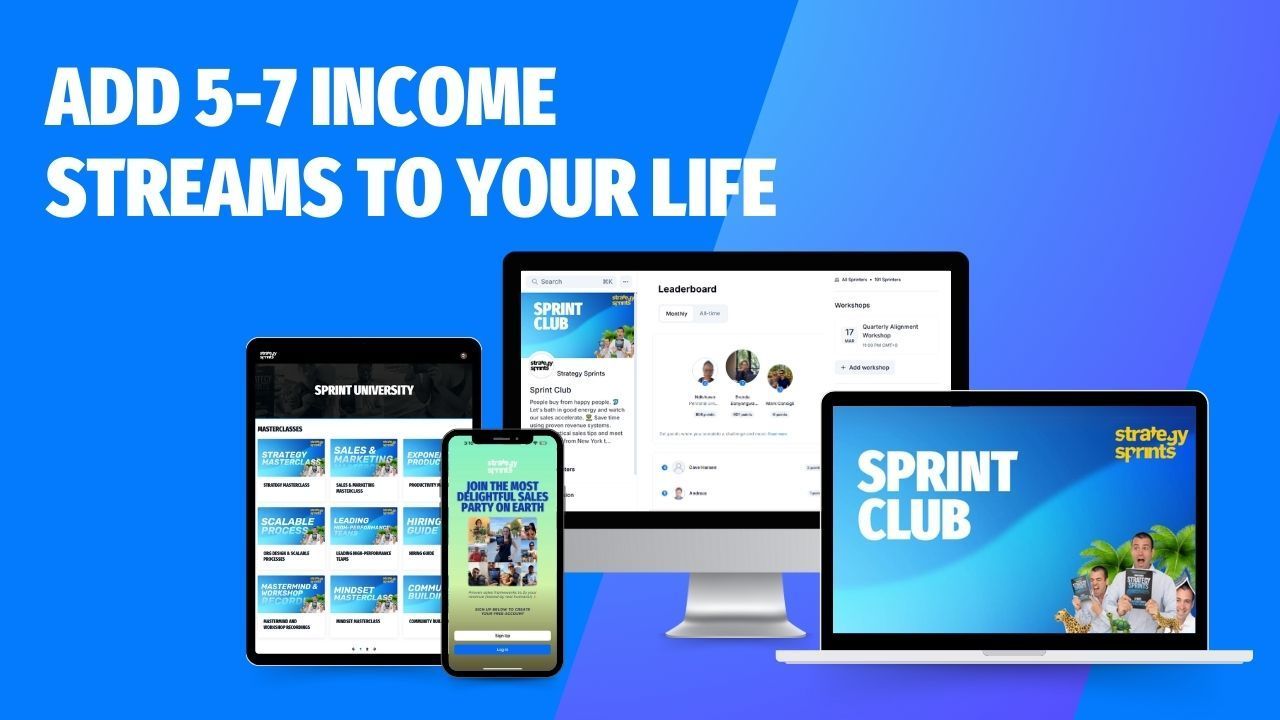
And you don't do it alone. Rowers have a coach and a crew. In our Sales Gym, you have spotters who push you through your current sales wall, until the silence feels like home. Over 2,400 B2B founders have gone through our programs, and this is what we practice with them.
If you want the tools and a crew that practices this every week, join the Sprint Club: https://www.strategysprints.com
Ready to accelerate now? Book a Discovery Call: https://calendly.com/strategysprint/discovery-call
Happy hunting.
Simon & The Sprinters 🐬⚡️🐆
Lead your next deal, first call to signature. 🌴
The 36 Sales Gaps Checklist: 36 places a deal dies, and the fix for each. Free, one page.
Free. You get the checklist, then more sales tools like it by email from Strategy Sprints. Leave in one click, any time.