The B2B Sales Funnel for Founders: Why Consumer Funnels Break (and What Closes)
You want to double revenue. Fast. You want to stop being the only person in the company who can close. And you want the salespeople you hire to actually perform.
So you go looking for a B2B sales funnel for founders. And almost everything you find was built for someone else 🐬
It was built for consumer offers. Ads, a landing page, a checkout button. That works when the price is $47. It breaks when the deal is $10K, $30K, $50K and three people need to say yes.
Here is the funnel that works when you sell B2B. Plus the one thing inside it that decides whether deals close.
Why consumer funnels break in founder-led B2B
A consumer funnel is a machine for one decision. One person, one moment, one click.
A B2B deal is never one decision. It's a series of small yeses. Is this person worth a reply? Worth a call? Worth showing my partner? Worth the budget this quarter?
No landing page answers all of those. A conversation does.
That's the gap. Funnel templates optimize clicks. B2B revenue is decided in conversations 🐯
And when the template doesn't fit, the default fallback is the grind. More ads. More follow-ups. More "just checking in" emails. A discount at the end to get it over the line.
That's not a volume problem.. it's a control problem.
The real gap: control of the conversation
In most sales conversations, the seller isn't leading. The buyer sets the pace, the agenda and the price. The seller chases, waits and hopes.
Every seller has felt that moment. You hear yourself explaining a bit too much. A discount slips out that nobody asked for. The deal goes quiet at the finish line and the old playbook says: send a third follow-up.
Buyers feel that energy too. And it pulls win rates down.
The fix isn't a cleverer page. It's doing the right things, in the right order, at every stage of the journey 🌴
The B2B sales funnel for founders: 9 stages, not 3
Forget top, middle, bottom. A founder-led B2B funnel follows the buyer's journey. Nine stages. Each one has one job: move the buyer to the next one.
- Attention. Your ideal client notices you. Content, a podcast, a workshop, a referral, a sharp first message.
- Start a conversation. A first real reply, a DM, a sign-up, a booked call. Most consumer funnels skip this stage entirely.
- Continue the conversation. Follow-ups that add something. Not "bumping this to the top of your inbox."
- Create even more value. Give before you ask. An insight, a tool, a diagnostic, an event.
- Close. Statement of Work signed. Paid.
- Upsell. The bigger next step for the client who got results.
- Referrals. Clients and partners send you people.
- Retention. Clients stay and renew.
- Cross-sell. A second product for the same happy client.
Look where the money sits. Stages 6 to 9 all happen after the first sale. A consumer funnel ends at checkout. Yours is just getting started there 🐬
And look at what's missing: a button that closes a $30K deal on its own. In B2B, stage 5 is a conversation. So let's open it up.
Inside the close: the 8 Steps of the Repeatable Sale
Stage 5 is where founder-led companies get stuck. The founder closes well on instinct. Nobody else can copy instinct. So every big deal routes back to the founder.
The way out is a process a new hire can run without you. We teach the same 8 steps, in the same order, every time:
- Visualize. Picture what the buyer is describing. Mirror their last few words. Match their pace. Then lead. No trust, no step 2.
- Frustration. "What's the frustration? What have you already tried?" This is where buyers open up.
- Importance. "How important is this, in the context of everything else going on?" Now the problem is real, not a side topic.
- Cost of Inaction. "What happens if you do nothing?" Let them say it out loud. Then stay quiet.
- Deliverables. The buyer defines success in their own words. Those words become the Statement of Work.
- Investment. Time, then people, then money. In that order. Never lead with price.
- Starting Date. "To which starting date are we committing?" A date on the calendar, not "soon."
- Statement of Work. Sent before the next meeting, ready to sign, written in the buyer's language.
Why the order matters: a stalled deal has usually skipped a step. Price came up before the cost of inaction was clear. A proposal went out before the buyer had named the deliverables. The buyer wasn't saying no. They were saying "not yet" to a step that never happened 🐯
Run the steps in order and the chasing stops. You're not asking for the deal. You're walking the buyer through a decision they already want to make. That's control. Calm, never pushy.
(If you want to go deeper on this, here are the 4 moments where B2B deals actually stall.)
Measure the space between the stages
This is the part most funnel advice leaves out. Don't just count leads. Count the conversion between each stage and the next.
- Attention to conversations started
- Conversations started to booked calls
- Calls to signed Statements of Work
- Clients to upsells, referrals and renewals
One number per stage. One conversion rate between each pair. Then find the biggest drop.
That's your leakiest stage. Fix it first.
The temptation is to fix what's easiest to produce. More posts, more ads, more cold emails. But if calls convert poorly, more attention just pours more water into a leaking bucket 🌴
A few common leaks:
- Calls don't close? The leak is inside the 8 Steps. Listen back to a few calls and spot the step that got skipped.
- People read but don't reply? The leak is stage 2. The first message asks for too much, too soon.
- Clients love the work but rarely refer? Stage 7 has no system yet.
Fix one stage. Measure again next week. Repeat. That's the rhythm we run with every client: set the week on Monday, score it on Friday.
What about the Hormozi funnel?
A lot of founders come to this topic through Alex Hormozi. Fair. His thinking on offers is sharp, and we've written about why Alex Hormozi is a marketing genius.
Keep the offer thinking. Just remember where B2B deals close. Even a great offer still needs a conversation to land. The 9 stages and the 8 Steps are that conversation, made repeatable.
What it looks like when it works
Picture the call. The buyer talks, you mirror. You ask what they've already tried. Then the question: "What happens if you do nothing?" You hear the pause. You let it sit. They answer it themselves.
They name the deliverables. You walk through time, people, investment. They pick the start date. The Statement of Work lands in their inbox that afternoon, in their own words.
You didn't chase. You led 🐬
Now picture your new sales hire running that same call, the same way, while you take the evening off. That's the whole point of a repeatable sale.
We've taken 2,400+ B2B founders through our programs. Before Strategy Sprints, I coached 2,000+ teams, including Google, BMW and Airbus. And when a founder installs the right steps in the right order, we usually double revenue in 90 days.
Sprintlife
This is bigger than a funnel. Control in sales plus time freedom is what we call Sprintlife: fully present, full intensity, pursuing the dream. It comes back as money, thank-yous and purpose. The grind is the default path. It doesn't have to be yours 🐯
One move for this week: map your 9 stages, put one number on each, and find the biggest drop.
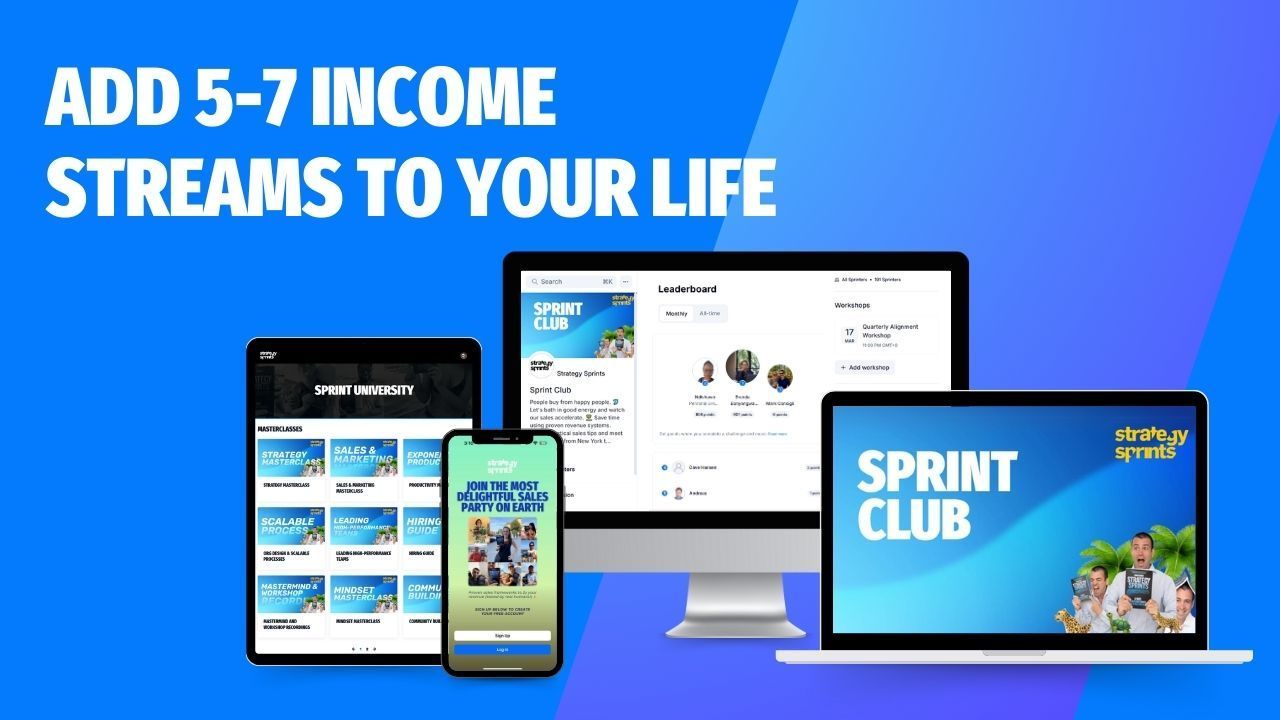
Want the tools, the AI skills and a community of founders running the same playbook? Join the Sprint Club (7-day free trial): www.strategysprints.com 🌴
Ready to accelerate now? Book a Discovery Call: https://calendly.com/strategysprint/discovery-call
Happy hunting.
Simon & The Sprinters 🐬⚡️🐆
Get our expert sales tips delivered
By submitting you agree to receive our weekly Strategy Sprints Newsletter as well as other promotional emails from Strategy Sprints. You may withdraw your consent at any time via the “Unsubscribe” link in any email or view our privacy policy at ant time.